10 October, 2026

One year after ceasefire announcement, killings continue across Gaza

A year after the announcement of a ceasefire in Gaza, Palestinians are still living under constant Israeli fire in attacks both near and far from the so-called “yellow line” that raise serious concern...

A year after the announcement of a ceasefire in Gaza, Palestinians are still living under constant Israeli fire in attacks both near and far from the so-called “yellow line” that raise serious concerns about continued crimes under international law, including war crimes.

“This is not life; this is endless torment with no end in sight. Human life has no value anymore,” said one father of three in Gaza. “There is not a single thing I can think of to ensure my children will survive from one minute to the next. We are constantly at the mercy of a random bullet, shelling, or an aerial attack. Sometimes it feels like they are playing games with our lives.”

Throughout the past year, Israeli attacks never ceased, killing and injuring Palestinians and causing recurrent displacement across Gaza. Over 1,400 Palestinians have been killed in Gaza according to the Palestinian Ministry of Health since the announcement of a ceasefire on 10 October 2025. UN Human Rights – OPT has so far verified1,076 conflict-related deaths between the ceasefire announcement and the end of July 2026, including 268 children, 126 women, and 682 men — women and children making up 37 per cent of all verified fatalities.

Since 7 October 2023, Israeli forces have killed over 20,000 children in Gaza, according to the Palestinian Ministry of Health. Since the announcement of a ceasefire in October 2025, UN Human Rights – OPT has verified the killing of 64 children in reported Israeli attacks that killed only children and no adults. This is in addition to 30 women and 10 more children killed in reported Israeli attacks in which all those killed were women or women and children with no men fatalities. The total proportion of civilian fatalities is likely much higher, as this number does not take into account all the civilian men killed in Gaza.
This pattern raises serious concerns that Israel is directing attacks against civilians not directly participating in hostilities — a war crime.

“Violence of this magnitude is outrageous at any time. To record it during a supposed ceasefire is simply unfathomable,” said Ajith Sunghay, Head of UN Human Rights – OPT. “Palestinians have endured these attacks while trapped within an ever-shrinking part of Gaza’s territory, surrounded from all sides by Israeli forces, and struggling to secure even the most basic necessities of life.”

The Israeli military has consistently expanded its deployment areas starting from nearly 53 per cent of Gaza’s territory at the time of the ceasefire announcement, with the objective of reaching 70 per cent of the territory as publicly stated by the Israeli Prime Minister. The boundary of these deployment areas has been commonly known as the “yellow line”, but monitoring over the past year demonstrates there is no single, identifiable line. Instead, Israeli forces continuously moved inwards, along ever-shifting lines not known to Palestinians, with frequent incursions into Palestinian communities.

While most verified fatalities have been recorded in reported Israeli attacks far away from Israeli military deployment areas, the conduct of Israeli forces around the so-called yellow lines raises serious concerns that it is being treated as a kill zone where lethal force is arbitrarily used.

A two-year-old boy was shot and killed in the early morning hours of 14 June 2026 in the arms of his father on their way to visit an aunt in Wadi Al Salqa, eastern Deir Al Balah. They were on a road approximately 150-200 meters west of the so-called “yellow line”, used routinely by Palestinians before the incident. On the way, the father saw a group of Israeli soldiers stationed at the entrance of an abandoned house in an apparent incursion west of the line. The soldiers were only 10 meters away, he told UN Human Rights – OPT, and they started shooting immediately.

“I saw my boy’s left eye come out of his face,” the father said. “As I realized a bullet penetrated his back and came out from his eye, another bullet struck me in the calf. I saw a bone fragment shoot out of my leg and land on the ground in front of me. I fell to the ground. My son was gasping for his last breath. I tightened my arms around him.”

The boy was taken away by soldiers, his father said, wrapped in a plastic sheet, “no longer moving or making any sounds”. The father was then stripped down, blindfolded, and dragged east, crossing the yellow line. Israeli soldiers moved him from vehicle to vehicle and from one site to another until he passed out from the bleeding around midnight.

“I woke up in Al Aqsa Martyrs Hospital in Deir Al Balah. I was informed that my son’s body was handed over as well. I do not know how and when we got there,” the father said.

Since the announcement of a ceasefire in October 2025, as of the end of July 2026, 331 Palestinians have been killed in the vicinity of the so-called yellow line as verified by UN Human Rights – OPT, including 66 children, 27 women, and 238 men. In many verified cases, there was no information to suggest the victims were posing any threat to Israeli forces. Many were carrying out ordinary civilian activities at the time of their killing, and some were killed while inside their tents. Targeting and killing civilians who are not directly participating in hostilities is a war crime regardless of their location or proximity to military deployment areas.


Sunghay reiterated UN Human Rights’ calls on third States to implement their duty to exercise influence over Israel to stop its violations of international law in Gaza, including by ceasing the supply of weapons and munitions facilitating serious violations of international law, and supporting the work of international accountability mechanisms.

“Accountability is not an afterthought or part of a distant future of recovery. It is a cornerstone of deterrence and non-recurrence. And it is already overdue,” he said.

21 August, 2026

Gaza: Civilians Continue to Pay the Price as Deadly Attacks Persist

Gaza: Civilians Continue to Pay the Price as Deadly Attacks PersistOn 18 and 19 August alone, at least 17 Palestinians, including children and women, were reportedly killed in Israeli attacks across G...

Gaza: Civilians Continue to Pay the Price as Deadly Attacks Persist

On 18 and 19 August alone, at least 17 Palestinians, including children and women, were reportedly killed in Israeli attacks across Gaza. Among the dead was a 13-year-old boy and his father killed in a strike on a seaside café, in addition to a 13-year-old girl killed in an attack on a police facility in Gaza City.

These incidents are a stark reminder that, despite occasional drops in the number of reported attacks, civilians throughout Gaza remain exposed to persistent, unpredictable, lethal harm.

Between 13 and 19 August, at least 22 Palestinians were reportedly killed in Israeli military attacks across Gaza. Under international humanitarian law, attacks directed at civilians, as well as indiscriminate and disproportionate attacks, are prohibited. Such attacks may amount to war crimes and other atrocity crimes.

The continuing pattern of attacks against police personnel and facilities in Gaza is alarming. UN Human Rights recorded an attack on 19 August on the Municipal Police headquarters in Gaza City, killing at least nine Palestinians, including a 13-year-old girl and eight police officers. Among the officers killed was the Director of the Women's Police in Gaza Governorate, Fatena Al-Sahar. The strike occurred in a densely populated area hosting large numbers of internally displaced people, injuring other civilians, including women and children.

Between January and August 2026, UN Human Rights has recorded at least 18 Israeli attacks against police personnel in Gaza, resulting in the killing of at least 77 Palestinians, including 57 police personnel, six children and four women. Six of these attacks were carried out since June.

Under international humanitarian law, police personnel are civilians protected against attacks. Targeting them is a war crime. They may lose this protection only if and for such time as they directly participate in hostilities. As the occupying Power, Israel has the obligation to ensure public order and safety. Such attacks further dismantle civilian law enforcement structures in Gaza and undermine protection to communities already subjected to wide-ranging human rights violations.

The concentration of casualties in these attacks, in densely populated civilian areas, including a café, a tent sheltering internally displaced people, a civilian vehicle, and police headquarters surrounded by displaced families, is part of a wider pattern of indiscriminate and disproportionate Israeli attacks against Palestinians documented by UN Human Rights since October 2023.

"It is hard to see any ‘military necessity’ of Israel’s ongoing attacks across a decimated landscape, which continue to kill and maim civilians, including children and police personnel,” said Ajith Sunghay, head of UN Human Rights’ office in Palestine. “The right to life is the foundational right for all. But it seems in Gaza, there is no respect left for human rights as death, injury and destruction continue day after day.”

18 June, 2026

Fatalities since ceasefire announcement in Gaza

More than 1,000 Palestinians killed in Gaza since the announcement of a ceasefire in October 2025. Here is what we know:  269 women and children among the 629 fatalities verified by UN Human Righ...

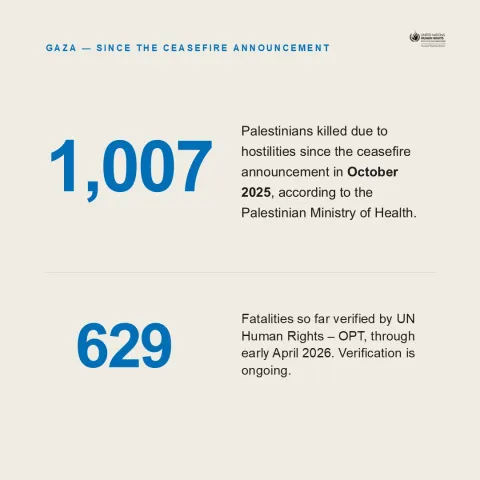
More than 1,000 Palestinians killed in Gaza since the announcement of a ceasefire in October 2025. Here is what we know:

Image
1,007 killed according to MOH, 629 verified killed so far

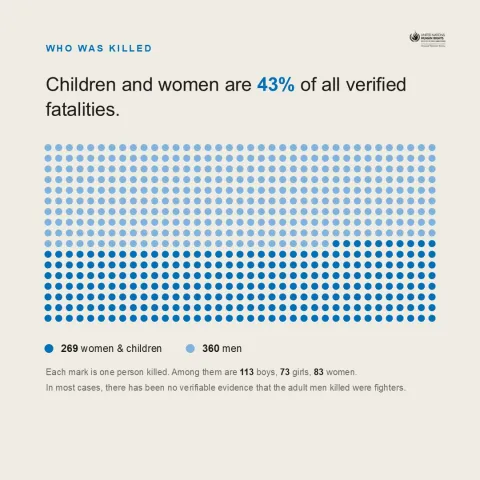
269 women and children among the 629 fatalities verified by UN Human Rights - Palestine in Gaza since the announcement of a ceasefire in October 2025 through early April, verification is ongoing.

Image
269 women and children among 629 verified fatalities

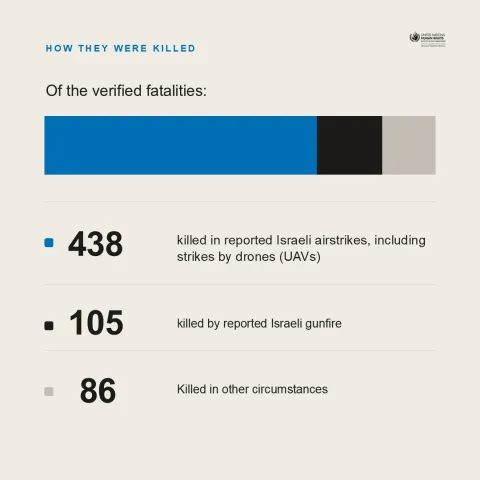
438 of the 629 verified fatalities since the announcement of a ceasefire in Gaza were killed in reported Israeli airstrikes, including strikes by unmanned aerial vehicles (UAVs).
 

Image
Breakdown of fatalities by reported means of killing

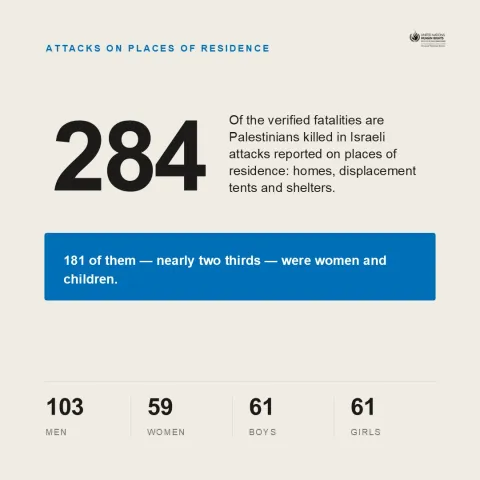
284 of the 629 fatalities verified by UN Human Rights - Palestine in Gaza since the ceasefire announcement were killed in their homes, tents, or shelters.

Image
284 killed in homes or shelters

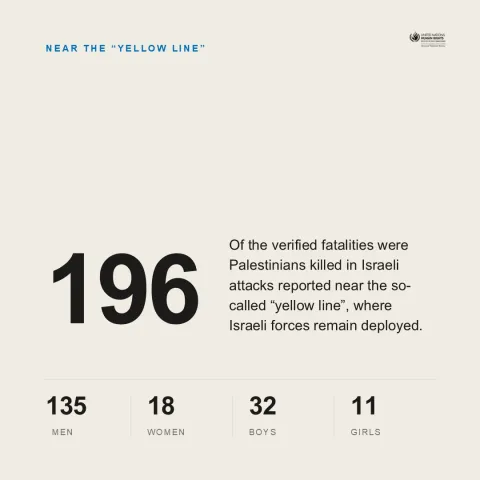
196 Palestinians were killed in Israeli attacks reported near the so-called "yellow line" out of the 629 fatalities verified by UN Human Rights - Palestine since the ceasefire announcement through early April.

Image
196 killings in the vicinity of the so-called yellow line

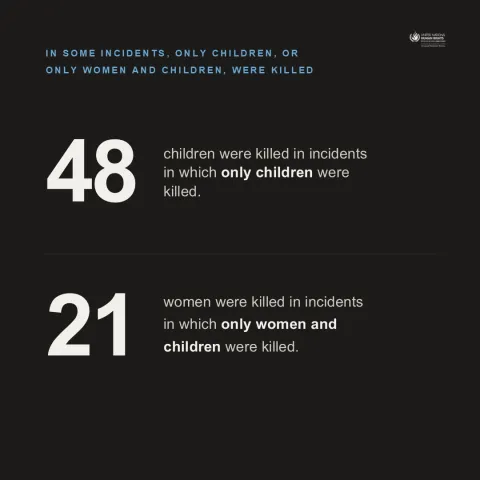
Since the ceasefire announcement in Gaza in October 2025, some incidents only killed children, or only killed women and children. 

Image
48 children killed in attacks whose victims were all children
3 June, 2026

UN Human Rights condemns repeated Israeli attacks on police personnel in Gaza

UN Human Rights condemns repeated Israeli attacks on police personnel in GazaThe UN Human Rights Office in the Occupied Palestinian Territory condemns Israeli forces’ routine targeting of police perso...

UN Human Rights condemns repeated Israeli attacks on police personnel in Gaza

The UN Human Rights Office in the Occupied Palestinian Territory condemns Israeli forces’ routine targeting of police personnel in Gaza in repeated attacks. Since January 2026, UN Human Rights has recorded at least twelve attacks against police, killing at least 53 civilians, including 35 police personnel, 5 boys, and 1 woman. Four attacks were recorded in May alone, killing 12 policemen.

Israeli attacks against police personnel have been reported during ordinary law enforcement operations, including directing traffic and patrolling streets and markets. The pattern demonstrated disregard for civilian lives, including that of police personnel, with several strikes taking place in crowded areas, killing, in addition to police personnel, internally displaced persons, children, and prison inmates.

On 23 May, an Israeli strike struck a police checkpoint in the Al Tawam area, Gaza City, killing at least five police officers and two others, including a boy. On 24 April 2026, an Israeli drone struck a police vehicle carrying out a law enforcement operation in the Beer 19 area of Al Mawasi camp, west of Khan Younis — a crowded encampment of displaced Palestinians. The attack killed four policemen, as well as three other men and a nine-year-old boy from nearby tents. It occurred at the time of sunset prayers, when many Palestinians were moving from their tents to a nearby mosque.

On 31 January 2026, an Israeli airstrike hit Ash Sheikh Radwan Police Station, northwest of Gaza City, killing at least 11 Palestinians, including five police officers, one of them a woman. Six more people, including a boy, were also killed in the airstrike, including inmates and people visiting the station for services.

The pattern of attacks raises concerns that Israeli forces apply no distinction between police personnel and fighters belonging to armed groups in Gaza. However, under international humanitarian law, police personnel are civilians who are protected against attack, unless and for such time as they directly participate in hostilities. Attacks targeting police personnel simply for performing ordinary law enforcement and policing functions would amount to war crimes.

The attacks also fit a broader pattern of Israel’s systematic failure to take constant care to spare civilians and civilian objects in its conduct of hostilities in Gaza. Even in the event that one or several of these attacks targeted fighters, the location and timing of the attacks in crowded areas and the use of weapons with wide-area effects indicate that Israeli forces have failed to take feasible precautions to avoid and minimize incidental loss of civilian life.

“As an occupying power, Israel has obligations under international humanitarian law to ensure, as far as possible, that Palestinians have public order and safety. Instead, the systematic targeting and dismantling of public governance institutions has created chaos with devastating impact on civilians,” said Ajith Sunghay, Head of UN Human Rights in the Occupied Palestinian Territory. “Nearly eight months have passed since the announcement of a ceasefire, and there is no end in sight for the killings, the turmoil, and the misery.”

23 January, 2026

Gaza: Civilian killings continue after ceasefire

UN Human Rights in the Occupied Palestinian Territory (OPT) is horrified by the continued killing of civilians in Israeli attacks in Gaza including at least 11 Palestinians killed in a series of attac...

UN Human Rights in the Occupied Palestinian Territory (OPT) is horrified by the continued killing of civilians in Israeli attacks in Gaza including at least 11 Palestinians killed in a series of attacks on 21 January, amid a broader pattern of post-ceasefire violence and the enduring effects of two years of devastation.

The 21 January attacks included an Israeli strike on a car which killed three Palestinian journalists near Netzarim area in central Gaza after conducting a photography assignment for the Egyptian Relief Committee. The killing of Anas Ghneim, Abdel Raof Shaat, and Muhammad Salah Qishta brings the number of journalists killed in Israeli attacks since 7 October 2023 to 292, as verified by UN Human Rights in OPT.

Israeli ground forces reportedly opened fire and carried out artillery shelling in three incidents on 21 January in the vicinity of their deployment line, known as the “yellow line”, which remains not clearly marked on the ground. The attacks reportedly killed a 13-year-old boy east of Khan Younis, and three family members including a father and his 13-year-old son in Middle Gaza. Israeli shelling also reportedly killed three Palestinian brothers northeast of Al Bureij camp in Middle Gaza.

Trends documented by UN Human Rights in the OPT since the ceasefire came into effect on 11 October 2025 include the continued killing of civilians in Israeli aerial attacks, shelling, and gunfire across all five governorates of Gaza, including incidents both far from and in the vicinity of the “yellow line”. Overall, 477 Palestinians were reportedly killed in Israeli attacks in Gaza since the ceasefire according to the Palestinian Ministry of Health, most appear to be civilian.

Since the ceasefire until 21 January 2026, UN Human Rights in the OPT recorded the killing of at least 216 Palestinians, including at least 46 children and 28 women, in Israeli attacks far from the so-called “yellow line”, mainly on shelters of internally displaced persons and residential buildings. This included 126 reported attacks by Israeli unmanned aerial vehicles (UAV) across Gaza resulting in the killing of at least 87 Palestinians, including 12 children and seven women.

In the same period, at least 167 Palestinians were reportedly killed in the vicinity of the “yellow line”, including 26 children and 17 women. Repeated Israeli military operations into areas west of the redeployment line have also led to the displacement of civilians and the demolition of residential buildings in those areas.

More civilians are dying due to the dire human-made humanitarian conditions, including at least nine children who died of hypothermia since the ceasefire.

UN Human Rights in the OPT has also recorded at least 80 reported killings of Palestinians by Hamas since the ceasefire, mostly in clashes with rival families and in summary executions. Hamas must respect international human rights law protections of persons under its control and must prevent and repress any violation of these rights committed by its members.

The persistent stream of civilian casualties raises concern that the Israeli military continues to disregard its obligations under international humanitarian law and international human rights law, including the right to life. The killings around the so-called “yellow line” also appear to involve the targeting of civilians not directly participating in hostilities on the sole basis of their proximity to deployment lines, which would constitute a war crime.

“The crisis in Gaza is nowhere near over. People are dying every day, both in Israeli attacks and as a result of continued Israeli restrictions on the entry of humanitarian assistance, in particular shelter, leading to deaths from the cold and under collapsing buildings. Palestinian journalists are killed, and international journalists are still barred from entering Gaza,” said Ajith Sunghay, Head of UN Human Rights in the OPT.

“This is a time for the international community to intensify support and pressure to stop the bloodshed and advance a rights-based approach to recovery and reconstruction.”

1 June, 2025

Gaza: Israeli Military Kills 32 Palestinians Seeking Food Aid as 'Militarised Humanitarian Mechanism' Deepens Crisis

It is reported today that the Israeli military killed at least 32 Palestinians trying to access food today at distribution points set up in northwestern Rafah and Middle Gaza by the so-called ‘Gaza Hu...

It is reported today that the Israeli military killed at least 32 Palestinians trying to access food today at distribution points set up in northwestern Rafah and Middle Gaza by the so-called ‘Gaza Humanitarian Foundation’ (GHF) and Safe Research Solutions (SRS), an American security company tasked by Israel with distributing food.

In the early morning of 1 June, the Israeli military reportedly shot at Palestinians trying to reach the aid distribution points in northwestern Rafah. According to the Gaza Ministry of Health, there were over 200 Palestinian casualties, including 31 killed and dozens seriously injured. Around the same time, in a similar incident close to another distribution point south of the Netzarim corridor in Middle Gaza, at least 1 person was shot and killed, and 42 were injured. While more information is being gathered, in both locations, the casualties reportedly include children and women.

The killings today follow numerous reports of the lethal use of firearms against Palestinians approaching GHF distribution points in Rafah and Middle Gaza since this new mechanism was established late last month. Between 27 and 31 May, the UN Human Rights Office in the Occupied Palestinian Territory (OPT) had already recorded daily violence connected with the mechanism, including reports of at least 19 Palestinians killed and 80 injured in total. At least 2 Palestinians were reportedly missing.

The UN Human Rights Office OPT stresses once more that Israel’s militarised humanitarian assistance mechanism violates international standards on aid distribution, endangers civilians, and is contributing to the catastrophic situation in Gaza. The 20 months of hostilities, Israel’s destruction of civilian infrastructure across Gaza, the almost 3 months of complete siege and blockade of Gaza, attacks on community kitchens, as well as the unlawful targeting of civilians including the police force, have led to a break down in civil order and is forcing on Palestinians the stark choice of dying from starvation or risk being killed while trying to access the meagre food that is being made available through the GHF.

The weaponisation of food for civilians and restricting or preventing their access to other life sustaining services constitute a war crime and may constitute elements of other international crimes, including genocide.

Israel, as the occupying power, has the duty, to the fullest extent of the means available to it, to ensure the provision of food and medical care for the population commensurate with their needs. They have further obligations to facilitate access by international humanitarian service providers and to facilitate the access of the civilian population to that assistance. The Office recalls that in 2024 the International Court of Justice, having found that there was a real and imminent risk of irreparable prejudice to the plausible rights of Palestinians in Gaza under the Genocide Convention, issued binding orders on Israel to take all measures to ensure, without delay, and in cooperation with the UN, the unhindered provision at scale of aid and assistance to Gaza.

As a matter of urgency, Israel must immediately comply if further unnecessary deaths of Palestinian civilians are to be prevented. 

25 April, 2025

Deteriorating human rights and humanitarian situation in the Occupied Palestinian Territory

For the past 18 months, hostilities in Gaza and severe restrictions on humanitarian assistance, which now include a complete blockade, have devastated the lives of 2.2 million Palestinians, and nearly...

For the past 18 months, hostilities in Gaza and severe restrictions on humanitarian assistance, which now include a complete blockade, have devastated the lives of 2.2 million Palestinians, and nearly all essential infrastructure that civilians depend on for survival has been destroyed. Since the collapse of the ceasefire, and during the past week in particular, Israeli attacks on Palestinians have accelerated, claiming the lives of countless civilians and further risking the complete destruction of what little infrastructure remains. The dire conditions for civilians have been further exacerbated by displacement orders and Israel’s renewed complete blockade of the Gaza Strip that has stopped the flow of life saving, critical assistance from reaching increasingly desperate civilians.

In parallel, rampant settler violence and operations conducted by Israeli security forces in the West Bank are continuing to kill or injure Palestinians and are resulting in the forced displacement of Palestinians from their homes or shelters in many areas.

Attacks in Gaza

What little remains of Gaza’s critical life-saving infrastructure is collapsing under the conditions inflicted by Israel. Israel’s complete closure of Gaza, preventing lifesaving assistance from reaching civilians - including food and fuel - has now entered its eighth week. Bakeries have stopped functioning due to the lack of flour and cooking fuel; the prices of basic food items are soaring; and Israeli attacks at sea continue to decimate Gaza’s fishing industry. With food aid halted, remaining stocks in Gaza are rapidly depleting, rendering the strip’s population, especially vulnerable groups and children, at growing risk of starvation.

As the population becomes increasingly desperate due to the scarcity of food and other vital provisions, social unrest is deepening further, with frequent reports of disputes breaking out within the community involving the use of firearms. This takes place in an environment where the law enforcement and justice system has been systematically dismantled by Israeli attacks and the targeting of civilian officials of the local administration.

The Israeli military also continues targeting civilian objects indispensable to the survival of the civilian population. Between 21 and 22 April, the Israeli military conducted deliberate and coordinated attacks across three governorates in Gaza, resulting in the destruction of 36 heavy machines, including excavators, water trucks, and sewer suction tanks. These were being used by Gaza municipalities for humanitarian relief operations, such as rubble removal, water distribution, and maintenance of vital sanitation systems. The destruction of these vehicles is likely to significantly hinder rescue operations, including retrieval of the injured and killed from under the rubble, clearance of debris to allow the movement of ambulances, as well as delivery of safe drinking water, solid waste collection, and the operation of sewage systems – further risking outbreaks of disease. Intentional attacks on civilian objects, that is, objects that are not used for military action and whose destruction does not offer a definite military advantage at the moment of the attack, are unlawful and constitute a war crime under international humanitarian law.

The Israeli military also continues striking the shelters of Palestinians in Gaza. Between 18 March and 22 April, the UN Human Rights office for the Occupied Palestinian Territory recorded 229 attacks on residential buildings and 91 attacks on tents of internally displaced people (IDP) in Gaza, most resulting in fatalities, including many children and women. For instance, at around midnight on 18 April, the Israeli military is reported to have struck two residential buildings belonging to the Maqdad and the Nasio families in Tal Az-Za’atar, North Gaza, killing 13 Palestinians, including 8 children and a journalist, Tamer Maqdad, and injuring others. On 24 April, at around 0300 hours, the Israeli Air Force reportedly hit a house, in Ash Shaikh Redwan, Gaza City, killing two boys and a girl along with their parents. Among these attacks, 36 strikes on IDP tents were reported to have taken place in Al Mawasi area in southern Gaza in which the Israeli military has repeatedly ordered residents of other areas to relocate.

Persistent Israeli military attacks on civilians and civilian objects have continued throughout Gaza in violation of the core principles of distinction, proportionality and precautions in attack required by international humanitarian law. Extremely high civilian casualties over 18 months do not appear to have prompted any changes in Israeli targeting practices and policies, a pattern indicating at the very least a complete disregard for the lives of civilians in Gaza. Matched with Israel’s policy of deliberately blocking life-saving assistance from entering the Gaza Strip, these policies appear to be aimed at punishing the civilian population of Gaza and inflicting on them conditions of life increasingly incompatible with their continued existence as a group in Gaza.

Third States must act according to their clear and unambiguous obligations under international law to ensure that such conduct ceases immediately and to search for and bring to justice perpetrators of crimes under international law.

Renewed wave of settler violence across the West Bank

In the West Bank, high levels of settler violence against Palestinians continue, causing death, injuries and loss of property and undermining Palestinian lives and livelihoods in many areas. On 23 April, Israeli settlers reportedly attacked Palestinians and their property in Khirbet al-Tell area of Sinjil village, Ramallah, resulting in the injury of eight young Palestinian men and the destruction of three agricultural structures. According to information gathered, Israeli security forces prevented emergency crews from reaching the wounded and extinguishing the fire. On 21 April, around 200 settlers burned three houses in the same community and stole sheep belonging to Palestinians, prompting confrontations with residents attempting to defend their properties.

Concerning incidents of settler violence resulting in Palestinian injuries and destruction of property were also recorded in other parts of the West Bank. In Bardala village in northern Jordan Valley, between 23 and 24 April, Israeli settlers reportedly injured seven Palestinians with live ammunition and set fire to residential tents and livestock shelters, while Israeli security forces delayed access of Palestinian ambulances to the area. On 17 April in Al-Rakeez village of Massafer Yatta, South Hebron Hills, a 60-year-old Palestinian man had his leg amputated after Israeli settlers shot him following an attempt to move a fence they had constructed around his land. Following the incident, Israeli security forces arrived at the scene and arrested the man’s 16-year-old son, claiming he had assaulted military personnel.

Israeli security forces continued the practice of unlawful killings and large-scale operations in the Northern West Bank

Over the past week, Israeli security forces killed three Palestinians who were throwing stones, including two children. This raised 192 the number of children killed by Israeli security forces in the West Bank since 7 October 2023. On 23 April, Israeli security forces opened fire at a group of children and killed a 12-year-old Palestinian boy with a bullet in the back after they threw stones at military armoured vehicles in Yamoun town, Jenin. On 17 April, Israeli security forces killed two Palestinians, including a 16-year-old boy and a 19-year-old man, who were throwing stones at a highway in Osarin village, Nablus.

Lethal force may only be used if it is strictly unavoidable to protect life; if other, less extreme measures could be used to achieve this objective, then the use of such lethal force constitutes an arbitrary deprivation of life.

Meanwhile, the large-scale operation in the northern West Bank entered its third month, with Israeli security forces continuing to prevent Palestinians from returning to their homes in the refugee camps of Jenin and Tulkarm, while carrying out widespread destruction coupled with the creation of pathways and barriers inside the camps and conducting daily raids on Palestinian towns and villages. With every day this operation continues, the prospect that Palestinians in affected camps will be able to return to their homes is diminishing, risking the permanent displacement of Palestinians from key West Bank population centres, amounting to forcible transfer. 
1 April, 2025

100 Palestinians killed in Gaza since the commencement of Eid

While families should be celebrating the end of #Ramadan, since the commencement of Eid, our Office has recorded at least 100 Palestinians killed in #Gaza, including at least 32 children. In 4 inciden...
21 March, 2025

Statement by the UN Human Rights Office in the Occupied Palestinian Territory on the developments in Gaza

The UN Human Rights office in the Occupied Palestinian Territory is horrified by the ongoing killing of hundreds of Palestinian civilians in Gaza since the resumption of large-scale Israeli bombardmen...

The UN Human Rights office in the Occupied Palestinian Territory is horrified by the ongoing killing of hundreds of Palestinian civilians in Gaza since the resumption of large-scale Israeli bombardment on 18 March. As of 20 March, at least 506 Palestinians were killed, including 200 children and at least 112 women according to the Palestinian Ministry of Health in Gaza.

Airstrikes and artillery shelling have struck homes, schools serving as shelters, and tents of internally displaced people — a pattern extensively documented by the UN Human Rights Office since October of 2023. The Israeli military appear to have resumed the practice of using explosive weapons with wide-area effects in densely populated areas. Across Gaza, since 18 March, the UN Human Rights office in the Occupied Palestinian Territory recorded at least three incidents where more than twenty fatalities were reported, and at least eight incidents with more than ten fatalities. Using explosive weapons with wide- area effects in such densely populated areas will almost certainly have indiscriminate effects and is very likely to be in violation of international humanitarian law rules on the conduct of hostilities.

Conducting hostilities using such means and methods in densely populated areas causes civilian casualties at a mass scale and is not consistent with Israel’s obligations under international humanitarian law, including abiding by the fundamental principles of distinction, proportionality, and precautions in attack.

On 20 March, Hamas’s military wing, Al Qassam Brigades, announced firing rockets on Tel Aviv. No casualties were reported. The targeting of civilians or launching of indiscriminate attacks amounts to a war crime.

Israel is again issuing forced displacement orders across Gaza and imposing severe movement restrictions. On 19 March, the Israeli military announced redeployment in Netzarim corridor which separates the north of Gaza from the south and prohibited Palestinians from moving through Salah Ad Deen road. The Israeli military ordered all Palestinians residing in areas located in the vicinity of the fence, described as “dangerous combat zones”, to leave to “known shelters” in western Gaza City and Khan Yunis.

The return of heavy bombardment and mass displacement orders indicates a resurgence of the pattern which has already forced 90 per cent of Palestinians in Gaza into displacement before the ceasefire, often more than once. The devastating impact of mass forced displacement will likely be exacerbated by Israel’s blocking of humanitarian aid, the already catastrophic shelter crisis in Gaza, and the lack of access to life- saving services.

Statements by the Israeli government further heighten fears about the deliberate flouting international law prohibitions and further collective punishment.

On the evening of 19 March, a statement by the Israeli Minister of Defence addressed to “residents of Gaza” threatened “significantly worse” strikes if hostages are not released and if Hamas is not expelled from Gaza, stressing that Gaza residents “will pay the price”. The statement referred to the “option” of “relocating to other parts of the world” if Palestinians “wish” to do so after the demands he outlined are met.

“The alternative”, the statement continued, “is utter destruction and devastation.”

Other statements by Israeli officials explicitly said that one of the goals of the renewed bombardment aims to “damage Hamas’s governmental capabilities” through targeting mid-level and senior-ranking members in Hamas’s Political Bureau, including officials in the civilian de-facto authorities— who, under international law, are civilians entitled to protection except if, and for such time, they directly participate in hostilities. Some civilian officials were reportedly killed with their entire families and children, including Ahmed Al Hatta, Undersecretary for the Ministry of Justice, who was killed with his wife and six children.

Violations by one party to the conflict never justify violations by the other. The targeting of civilians and civilian infrastructure across Gaza and any measures constituting forcible transfer of the civilian population or collective punishment are violations of international law and are war crimes.

The heightened Israeli siege since 2 March, which has prevented basic necessities from reaching civilians amounts to collective punishment. We recall that in its March 2024 binding order, the International Court of Justice unanimously ordered Israel to take all necessary and effective measures to ensure the unhindered provision at scale of urgently needed basic services and humanitarian assistance to Palestinians throughout Gaza, to conform with its obligations under the Convention on the Prevention and Punishment of the Crime of Genocide.

Israel is legally bound to immediately end and punish breaches of international law, and as the occupying power, to protect Palestinian civilians from violence, ensure the provision of all necessities of life, and ensure they can return to their homes in safety and dignity.

We repeat our call on member states to take decisive action to end hostilities in Gaza and ensure accountability for the grave breaches of international law committed over the past year and a half.