10 October, 2026

One year after ceasefire announcement, killings continue across Gaza

A year after the announcement of a ceasefire in Gaza, Palestinians are still living under constant Israeli fire in attacks both near and far from the so-called “yellow line” that raise serious concern...

A year after the announcement of a ceasefire in Gaza, Palestinians are still living under constant Israeli fire in attacks both near and far from the so-called “yellow line” that raise serious concerns about continued crimes under international law, including war crimes.

“This is not life; this is endless torment with no end in sight. Human life has no value anymore,” said one father of three in Gaza. “There is not a single thing I can think of to ensure my children will survive from one minute to the next. We are constantly at the mercy of a random bullet, shelling, or an aerial attack. Sometimes it feels like they are playing games with our lives.”

Throughout the past year, Israeli attacks never ceased, killing and injuring Palestinians and causing recurrent displacement across Gaza. Over 1,400 Palestinians have been killed in Gaza according to the Palestinian Ministry of Health since the announcement of a ceasefire on 10 October 2025. UN Human Rights – OPT has so far verified1,076 conflict-related deaths between the ceasefire announcement and the end of July 2026, including 268 children, 126 women, and 682 men — women and children making up 37 per cent of all verified fatalities.

Since 7 October 2023, Israeli forces have killed over 20,000 children in Gaza, according to the Palestinian Ministry of Health. Since the announcement of a ceasefire in October 2025, UN Human Rights – OPT has verified the killing of 64 children in reported Israeli attacks that killed only children and no adults. This is in addition to 30 women and 10 more children killed in reported Israeli attacks in which all those killed were women or women and children with no men fatalities. The total proportion of civilian fatalities is likely much higher, as this number does not take into account all the civilian men killed in Gaza.
This pattern raises serious concerns that Israel is directing attacks against civilians not directly participating in hostilities — a war crime.

“Violence of this magnitude is outrageous at any time. To record it during a supposed ceasefire is simply unfathomable,” said Ajith Sunghay, Head of UN Human Rights – OPT. “Palestinians have endured these attacks while trapped within an ever-shrinking part of Gaza’s territory, surrounded from all sides by Israeli forces, and struggling to secure even the most basic necessities of life.”

The Israeli military has consistently expanded its deployment areas starting from nearly 53 per cent of Gaza’s territory at the time of the ceasefire announcement, with the objective of reaching 70 per cent of the territory as publicly stated by the Israeli Prime Minister. The boundary of these deployment areas has been commonly known as the “yellow line”, but monitoring over the past year demonstrates there is no single, identifiable line. Instead, Israeli forces continuously moved inwards, along ever-shifting lines not known to Palestinians, with frequent incursions into Palestinian communities.

While most verified fatalities have been recorded in reported Israeli attacks far away from Israeli military deployment areas, the conduct of Israeli forces around the so-called yellow lines raises serious concerns that it is being treated as a kill zone where lethal force is arbitrarily used.

A two-year-old boy was shot and killed in the early morning hours of 14 June 2026 in the arms of his father on their way to visit an aunt in Wadi Al Salqa, eastern Deir Al Balah. They were on a road approximately 150-200 meters west of the so-called “yellow line”, used routinely by Palestinians before the incident. On the way, the father saw a group of Israeli soldiers stationed at the entrance of an abandoned house in an apparent incursion west of the line. The soldiers were only 10 meters away, he told UN Human Rights – OPT, and they started shooting immediately.

“I saw my boy’s left eye come out of his face,” the father said. “As I realized a bullet penetrated his back and came out from his eye, another bullet struck me in the calf. I saw a bone fragment shoot out of my leg and land on the ground in front of me. I fell to the ground. My son was gasping for his last breath. I tightened my arms around him.”

The boy was taken away by soldiers, his father said, wrapped in a plastic sheet, “no longer moving or making any sounds”. The father was then stripped down, blindfolded, and dragged east, crossing the yellow line. Israeli soldiers moved him from vehicle to vehicle and from one site to another until he passed out from the bleeding around midnight.

“I woke up in Al Aqsa Martyrs Hospital in Deir Al Balah. I was informed that my son’s body was handed over as well. I do not know how and when we got there,” the father said.

Since the announcement of a ceasefire in October 2025, as of the end of July 2026, 331 Palestinians have been killed in the vicinity of the so-called yellow line as verified by UN Human Rights – OPT, including 66 children, 27 women, and 238 men. In many verified cases, there was no information to suggest the victims were posing any threat to Israeli forces. Many were carrying out ordinary civilian activities at the time of their killing, and some were killed while inside their tents. Targeting and killing civilians who are not directly participating in hostilities is a war crime regardless of their location or proximity to military deployment areas.


Sunghay reiterated UN Human Rights’ calls on third States to implement their duty to exercise influence over Israel to stop its violations of international law in Gaza, including by ceasing the supply of weapons and munitions facilitating serious violations of international law, and supporting the work of international accountability mechanisms.

“Accountability is not an afterthought or part of a distant future of recovery. It is a cornerstone of deterrence and non-recurrence. And it is already overdue,” he said.

3 September, 2026

Bloodshed in Gaza must come to an end

Almost a year since a ceasefire was announced and nowhere and nobody in Gaza is safe. Twenty-four Palestinians have been killed in Israeli attacks in the five days between 28 August and 1 September, i...

Almost a year since a ceasefire was announced and nowhere and nobody in Gaza is safe. Twenty-four Palestinians have been killed in Israeli attacks in the five days between 28 August and 1 September, including four children and a woman. Twenty-one were killed in airstrikes.

Palestinian armed elements’ operations with the reported support of Israeli forces are causing civilian harm. On 1 September, according to initial information, the Israeli military conducted a raid into Al-Katiba area in West Gaza city accompanied by Palestinian armed elements under the cover of multiple airstrikes, killing a 3-year-old girl and a 13-year-old boy, and a 31-year-old man.
The fourth victim was a 49-year-old woman, the wife of 51-year-old Moein Al Arbeed, a colonel with the de-facto Internal Security Agency who has been detained by Israeli forces during the raid.

Israel’s stated pursuit of individuals that it alleges to be lawful targets does not suspend its international humanitarian law or international human rights law obligations, including in relation to Palestinians’ right to life. Nor does it justify the daily terror Palestinians are subjected to in Gaza. This bloodshed must finally come to an end. There must be justice and accountability for all the unlawful killings and other violations in Gaza.

18 June, 2026

Fatalities since ceasefire announcement in Gaza

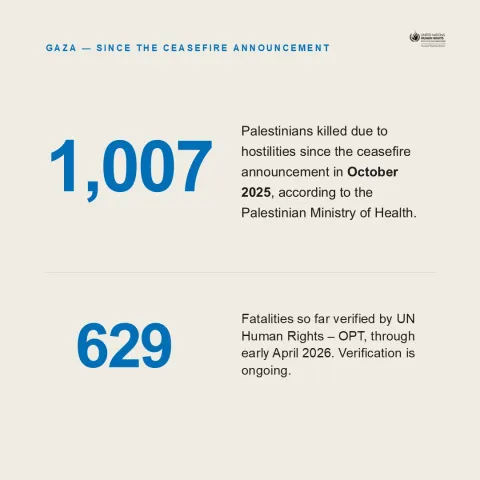
More than 1,000 Palestinians killed in Gaza since the announcement of a ceasefire in October 2025. Here is what we know:  269 women and children among the 629 fatalities verified by UN Human Righ...

More than 1,000 Palestinians killed in Gaza since the announcement of a ceasefire in October 2025. Here is what we know:

Image
1,007 killed according to MOH, 629 verified killed so far

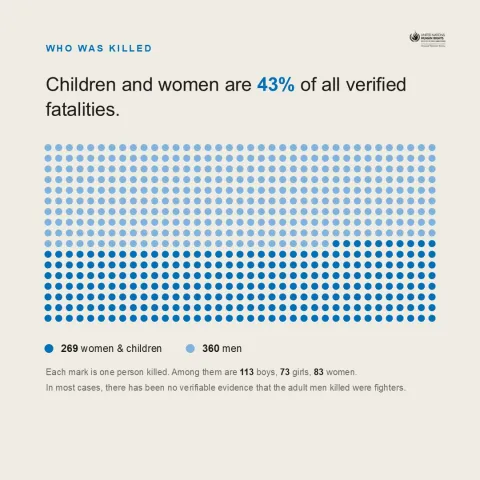
269 women and children among the 629 fatalities verified by UN Human Rights - Palestine in Gaza since the announcement of a ceasefire in October 2025 through early April, verification is ongoing.

Image
269 women and children among 629 verified fatalities

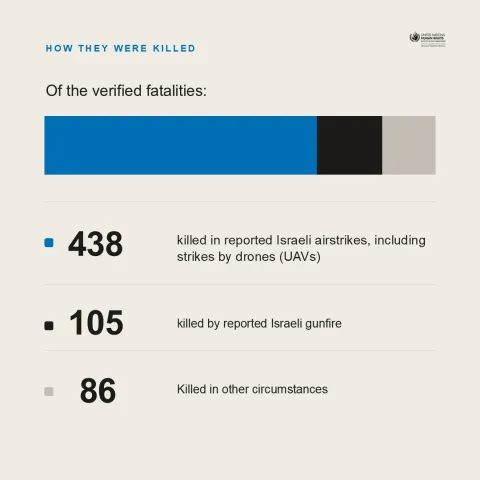
438 of the 629 verified fatalities since the announcement of a ceasefire in Gaza were killed in reported Israeli airstrikes, including strikes by unmanned aerial vehicles (UAVs).
 

Image
Breakdown of fatalities by reported means of killing

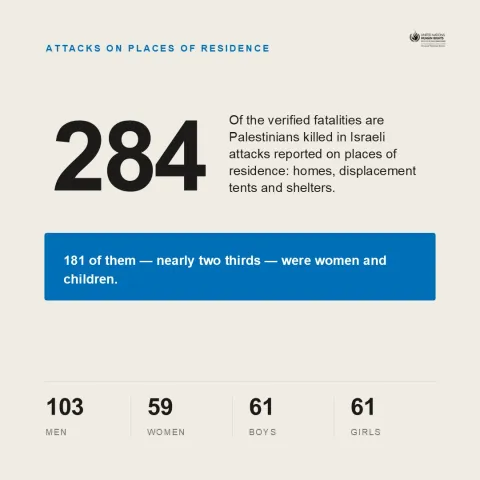
284 of the 629 fatalities verified by UN Human Rights - Palestine in Gaza since the ceasefire announcement were killed in their homes, tents, or shelters.

Image
284 killed in homes or shelters

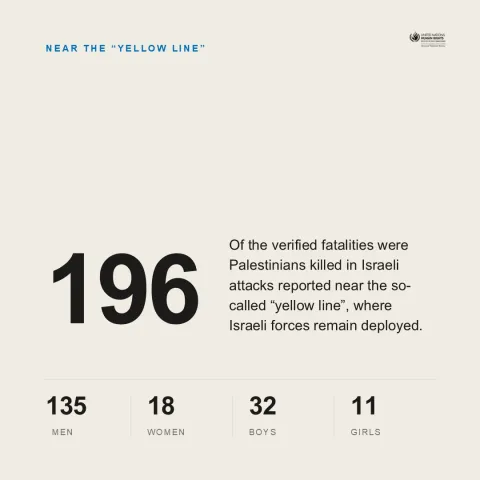
196 Palestinians were killed in Israeli attacks reported near the so-called "yellow line" out of the 629 fatalities verified by UN Human Rights - Palestine since the ceasefire announcement through early April.

Image
196 killings in the vicinity of the so-called yellow line

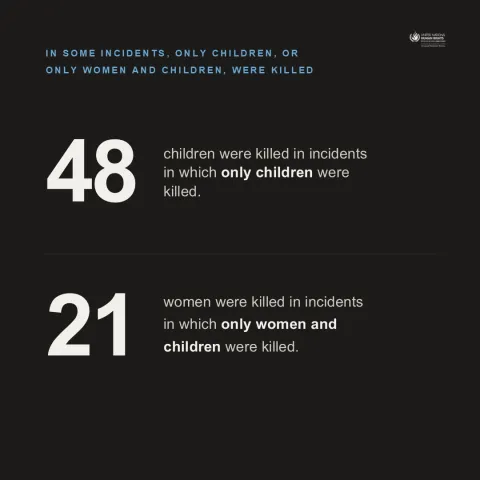
Since the ceasefire announcement in Gaza in October 2025, some incidents only killed children, or only killed women and children. 

Image
48 children killed in attacks whose victims were all children
29 May, 2026

Attacks on Gaza over Eid kill 26, as Israeli forces push deeper into the strip

Attacks on Gaza over Eid kill 26, as Israeli forces push deeper into the stripUN Human Rights in the Occupied Palestinian Territory (OHCHR OPT) condemns the increase in Israeli attacks in Gaza since t...

Attacks on Gaza over Eid kill 26, as Israeli forces push deeper into the strip

UN Human Rights in the Occupied Palestinian Territory (OHCHR OPT) condemns the increase in Israeli attacks in Gaza since the eve of Eid Al Adha on Tuesday, 26 May. At least 26 Palestinians were killed since Tuesday including six women and seven children as Palestinian families prepared to observe Eid amid displacement, deprivation, and insecurity.

Three airstrikes on 26 May killed 12 Palestinians. In the early morning hours, one more 14-year-old girl died of injuries sustained in an Israeli airstrike the day before that also killed a 30-year-old woman and a five-year-old girl according to initial information. Since the announcement of a ceasefire, at least 32 children and eight women have been killed in Israeli attacks in which fatalities were exclusively women and children.

One of the airstrikes on 26 May killed four men in eastern Al Maghazi camp, Middle Gaza, reportedly after they resisted attempts to search their homes by armed gangs allegedly supported by the Israeli military. Another airstrike hit a car in Al Mawasi, Khan Younis, killing two men. The third airstrike struck an apartment in Al Rimal, Gaza City, and killed a newly appointed commander of Hamas’s Al Qassam Brigades together with his wife, his two sons, aged 15 and 22, his daughter, aged 9, and a woman passerby.

On the first day of Eid Al Adha, 27 May, an Israeli airstrike in central Gaza City reportedly killed at least ten: four girls, one boy, three women, and two men allegedly affiliated with Al Qassam Brigades.

Since the announcement of a ceasefire, Israeli forces have killed 922 Palestinians in attacks across Gaza, bringing the total death toll since 7 October 2023 to nearly 73,000.

OHCHR OPT has consistently warned that Israel’s attacks in Gaza violate international humanitarian law’s principles of distinction, proportionality, and precaution in attacks. A recent OHCHR OPT report also concluded that the totality of Israeli conduct in Gaza raises serious concerns about Israel’s compliance with its obligations to prevent acts prohibited under the Genocide Convention.

The Israeli blockade on Gaza is also still depriving Palestinians of necessities, including adequate shelter, essential medicines, and food items. Almost everyone is displaced and concentrated into less than half the land area of Gaza— hemmed in by Israeli ground forces that continue to move west, displacing families and pushing them into a progressively narrower strip of land. In recent days, multiple displacement orders were issued, forcing people out of their shelters. The Israeli Prime Minister announced yesterday that he had directed Israeli forces to expand their deployment to cover 70 per cent of Gaza. The continued contraction of areas available to civilians raises grave concerns about access to humanitarian assistance, and the ability of displaced families to find any meaningful safety.

“Our concerns about the commission of war crimes in Gaza have not stopped,” said Ajith Sunghay, Head of UN Human Rights in the Occupied Palestinian Territory. “It is difficult enough to navigate life in chronic displacement in the ruins of Gaza, under blockade, and after Israeli attacks virtually destroyed every essential system: healthcare, education, food production, law enforcement and civil order. Continuing military attacks on a population living under these conditions is unthinkable.”

30 March, 2026

International Women's Day - Remarks by Ajith Sunghay, Head of UN Human Rights - Palestine

Remarks by Ajith Sunghay, Head of UN Human Rights - PalestineInternational Women's Day- closing eventExcellency Minister Mona Al Khalili, Amb Tarja, RC Ramiz and my dear colleagues,Born into Israeli o...

Remarks by Ajith Sunghay, Head of UN Human Rights - Palestine

International Women's Day- closing event

Excellency Minister Mona Al Khalili, Amb Tarja, RC Ramiz and my dear colleagues,

Born into Israeli occupation, under Israeli blockade, and amidst devastating violence, Palestinian women are leading precarious lives, exceedingly vulnerable to forced displacement, dispossession, arbitrary detention, loss, and constant fear.

More than a century has passed since International Women’s Day was born out of what was, essentially, a human rights movement. Millions of women in different parts of the world marched and organized to demand labor and voting rights.

In 2026, it is a shame that Palestinian women are still systematically denied their basic rights. This includes their right to life, to safety and security, to education and healthcare, to dignified living, and to protection, not only from gender inequality, but from racial segregation and apartheid.

A Palestinian woman’s life cycle is shaped by structural violence from childhood to adolescence, adulthood, and into old age.

As a child, she is not safe. In Gaza, more than 20,000 girls and boys were killed due to Israeli attacks since 7 October 2023. In the same period in the West Bank, roughly 1 in 5 of the 1072 Palestinians killed by Israeli forces and settlers are children. The youngest victim there was Laila, a 2-month-old baby girl who was killed by Israeli gunfire in her bed in Jenin.

The right to education is violated at a devastating scale: Israeli bombardment in Gaza destroyed most schools and led to the killing of over 17,000 school children since October 2023.In the West Bank, over 100 Palestinian school children were killed in the same period. Settler violence, discriminatory and excessive movement restrictions, as well as raids, operations, and detentions by Israeli security forces have also greatly disrupted schooling for girls and boys.

Palestinian girls experience adolescence under extremely harsh conditions.

How many girls are coming of age in displacement? How many have gotten their first menstruation without access to clean water and basic hygiene products? How many are now falling victim to negative coping mechanisms such as child marriage and sexual exploitation?

Later in life, Palestinian women’s exercise of their right to start a family is also uniquely fraught.

Pregnant and breastfeeding women in Gaza are struggling to get enough nutrition. Some had to watch their newborns and children starve to death at the peak of the hunger crisis caused by the Israeli blockade and aid restrictions. At least165 children died of hunger in Gaza since October 2023 — a slow, painful, and completely preventable death.

Women in Gaza are also struggling to exercise their right to access adequate healthcare. Israeli bombardment largely destroyed the healthcare system in Gaza with 60% of health delivery points currently non-functional. Of those that remain partially operational, only 15% are capable of providing emergency obstetric care.

Women’s right to work is another frontier of struggle.

Palestinian women are among the most educated in the region. They are also among the least economically active women in the world. The distance between those two facts is occupation, incessant violence, and associated skyrocketing unemployment.

Against the odds of occupation, as well as discrimination and gender inequality and gender-based violence in their own communities, Palestinian women are carving spaces to advocate for change, to extend help, and to bear witness.

The price has been heavy.

As teachers, healthcare professionals, journalists, and aid workers, Palestinian women have been killed and injured in the thousands alongside men by Israeli fire in Gaza.

Women human rights defenders and anti-occupation activists are locked up alongside men in Israeli detention facilities, suffering inhumane conditions, torture, and ill-treatment.

Women like Mayson, the 37-year-old mother from Gaza whose story we told on International Women’s Day, are not giving up on their missing loved ones. Mayson knows where her late husband is, but she can’t reach the rubble that became his grave in the north.

Thousands like Mayson are pacing between hospitals, morgues, and displacement sites in search of information about their family members.

Women’s lives, women’s choices should not be this difficult in 2026.

A girl should never have to choose between school and humiliation and violence at an Israeli checkpoint. A mother should never have to choose between watching her children die of hunger or getting herself killed in an aid queue. A woman should never have to choose between her freedom and her peaceful activism.

Every Palestinian woman and girl is entitled not merely to survive, but to live in freedom, equality, dignity, and peace.

This is a human rights crisis. The solution starts with ending the root causes of occupation, discrimination, violence, and impunity.
 

15 March, 2026

Alarm over pattern of unlawful killings with two Palestinian families killed and settlers terrorizing communities

Alarm over pattern of unlawful killings with two Palestinian families killed and settlers terrorizing communities UN Human Rights in the Occupied Palestinian Territory (OHCHR OPT) condemns the ki...

Alarm over pattern of unlawful killings with two Palestinian families killed and settlers terrorizing communities 

UN Human Rights in the Occupied Palestinian Territory (OHCHR OPT) condemns the killing of two Palestinian families by Israeli fire in Gaza and the West Bank on 15 March 2026 — incidents that raise serious concerns about a persistent trend of unlawful killings of Palestinians with impunity.

In Gaza, an Israeli airstrike reportedly struck one of the few houses still standing, in As Sawalha area in Az Zuwaida, Middle Gaza, and killed a man, his wife who was pregnant with twins, and their 10-year-old son, in addition to a 15-year-old boy in a nearby IDP tent. Later in the day, another attack by an Israeli unmanned aerial vehicle struck a car, also in Az Zuwaida, and killed eight Palestinian police personnel.

Since the announcement of the ceasefire in October 2025, 663 Palestinians were killed in Israeli military attacks both far from and in the vicinity of the redeployment line known as the “yellow line”, according to the Palestinian Ministry of Health.

Killing entire families together in homes and shelters has been a fixed feature of Israeli military activity in Gaza since 7 October 2023, wiping out generations at a time and causing a high number of civilian victims including women and children.

In the northern West Bank, Israeli security forces opened fire on car in Tammoun, south of Tubas, and killed a father, 37-year-old Ali Khalid Bani Odeh, a mother, 35-year-old Wa’ad Othman Bani Odeh, and their two youngest sons: 5-year-old Mohammad and 6-year-old Othman who also had visual and hearing impairment.

The two older sons, aged 8 and 11, survived and later provided an account to the media saying the Israeli soldiers physically assaulted them after killing their parents and siblings and said: “we killed dogs.”

The Palestinian Ministry of Health reported that all four family members were shot in the head. The father was reportedly also shot in the chest, thigh, and arm.

This brings the number of Palestinians killed by Israeli security forces and settlers in the occupied West Bank to 1071 since 7 October 2023, including 233 children.

The violence has markedly intensified since the start of the regional war on 28 February, with movement restrictions keeping Palestinians in locked silos while armed Israeli settlers and security forces roam free, raiding and attacking Palestinian communities across the West Bank.

On 14 March, Israeli settlers reportedly shot and killed 28-year-old Amir Odeh in an attack on Qusra, Nablus, and injured at least two more Palestinians including Odeh’s father.

This is the sixth Palestinian to be killed by settlers since the onset of the armed conflict in the region on 28 February, and the seventh since the beginning of 2026 — an alarming increase in pace compared to at least eight Palestinians killed by settlers in all of 2025.

In a separate attack on 13 March, residents of Khirbet Humsa in northern Jordan Valley reported to OHCHR OPT that settlers severely assaulted men and women in front of their children, stole livestock, and attacked two women international solidarity activists who were present to deter attacks.

One of the residents said he was sexually assaulted when settlers forcibly stripped him, put zip ties around his genitals and dragged him by the zip ties for a long distance. Settlers also reportedly threatened residents they will be back to kill them if they do not leave the community.

Unchecked settler violence has already driven away most of the Palestinian communities of the northern Jordan Valley.

Taken together, these incidents reflect a pattern of utter disregard for Palestinian lives that OHCHR OPT has documented with alarm, with complete impunity.

“Impunity is driving more killings, more displacement and dispossession, and more suffering for Palestinians across the occupied territory. Accountability for all violations of Palestinians’ rights is indispensable for any meaningful reversal of these disturbing patterns, not a luxury,” said Ajith Sunghay, Head of OHCHR OPT.

1 June, 2025

Gaza: Israeli Military Kills 32 Palestinians Seeking Food Aid as 'Militarised Humanitarian Mechanism' Deepens Crisis

It is reported today that the Israeli military killed at least 32 Palestinians trying to access food today at distribution points set up in northwestern Rafah and Middle Gaza by the so-called ‘Gaza Hu...

It is reported today that the Israeli military killed at least 32 Palestinians trying to access food today at distribution points set up in northwestern Rafah and Middle Gaza by the so-called ‘Gaza Humanitarian Foundation’ (GHF) and Safe Research Solutions (SRS), an American security company tasked by Israel with distributing food.

In the early morning of 1 June, the Israeli military reportedly shot at Palestinians trying to reach the aid distribution points in northwestern Rafah. According to the Gaza Ministry of Health, there were over 200 Palestinian casualties, including 31 killed and dozens seriously injured. Around the same time, in a similar incident close to another distribution point south of the Netzarim corridor in Middle Gaza, at least 1 person was shot and killed, and 42 were injured. While more information is being gathered, in both locations, the casualties reportedly include children and women.

The killings today follow numerous reports of the lethal use of firearms against Palestinians approaching GHF distribution points in Rafah and Middle Gaza since this new mechanism was established late last month. Between 27 and 31 May, the UN Human Rights Office in the Occupied Palestinian Territory (OPT) had already recorded daily violence connected with the mechanism, including reports of at least 19 Palestinians killed and 80 injured in total. At least 2 Palestinians were reportedly missing.

The UN Human Rights Office OPT stresses once more that Israel’s militarised humanitarian assistance mechanism violates international standards on aid distribution, endangers civilians, and is contributing to the catastrophic situation in Gaza. The 20 months of hostilities, Israel’s destruction of civilian infrastructure across Gaza, the almost 3 months of complete siege and blockade of Gaza, attacks on community kitchens, as well as the unlawful targeting of civilians including the police force, have led to a break down in civil order and is forcing on Palestinians the stark choice of dying from starvation or risk being killed while trying to access the meagre food that is being made available through the GHF.

The weaponisation of food for civilians and restricting or preventing their access to other life sustaining services constitute a war crime and may constitute elements of other international crimes, including genocide.

Israel, as the occupying power, has the duty, to the fullest extent of the means available to it, to ensure the provision of food and medical care for the population commensurate with their needs. They have further obligations to facilitate access by international humanitarian service providers and to facilitate the access of the civilian population to that assistance. The Office recalls that in 2024 the International Court of Justice, having found that there was a real and imminent risk of irreparable prejudice to the plausible rights of Palestinians in Gaza under the Genocide Convention, issued binding orders on Israel to take all measures to ensure, without delay, and in cooperation with the UN, the unhindered provision at scale of aid and assistance to Gaza.

As a matter of urgency, Israel must immediately comply if further unnecessary deaths of Palestinian civilians are to be prevented. 

19 May, 2025

Escalation of attacks in Gaza with a pattern of strikes on IDP tents and residential buildings, as well as on crowded hospitals

The Israeli military’s escalation of attacks in Gaza over the weekend raises further concerns that Israel is inflicting conditions of life on Palestinians increasingly incompatible with their continue...

The Israeli military’s escalation of attacks in Gaza over the weekend raises further concerns that Israel is inflicting conditions of life on Palestinians increasingly incompatible with their continued existence in Gaza as a group. These latest attacks, which are forcing people to move while they are being bombed, the methodical destruction of entire neighborhoods, and the denial of humanitarian assistance underline an apparent push for a permanent demographic shift in Gaza that is in defiance of international law and tantamount to ethnic cleansing. Palestinian civilians are dying under the bombs or from hunger. This is intolerable, and a ceasefire must be immediately agreed and implemented.

On 19 May the Israeli Defense Forces announced that they had struck '160 terror targets" across Gaza over the period of one day, which in the context of the existing destruction of infrastructure in Gaza, raises grave concerns that not all strikes were targeted at military objectives. Furthermore, the pattern of strikes on Internally Displaced People’s (IDP) tents and residential buildings, as well as on crowded hospitals, indicates that little, if any, care is being taken to protect the lives of civilians in Gaza, while reports of the use of weapons with wide area effects suggest deliberate, indiscriminate attacks.

Meanwhile, the humanitarian situation is beyond description. For the third consecutive month, Israel continues to prevent the entry and distribution of any items essential for life. Mass displacement continues as a result of bombings and strikes, the humanitarian catastrophe, and displacement orders, some of which no longer even identify areas where civilians should move. Around 150,000 people reportedly have been displaced in the last 24 hours alone. Displaced Palestinians are being forced onto the streets, with no shelter, and in most cases with no food, water or medical care. On 19 May, Israel issued more displacement orders impacting large areas of Khan Younis and Deir El Balah, which will result in further massive displacement, death, destruction, and push people into smaller areas.

Those who have been forced from their homes or other shelters remain under attack. In the last 48 hours, the Israeli military has intensified strikes, especially in North Gaza and Khan Younis and adjacent Deir al Balah in Middle Gaza, killing at least 96 Palestinians during the night and early morning of 17-18 May alone. In the last few days, the majority of Palestinians killed were in IDP tents, especially in the overcrowded Al Mawasi area in western Khan Yunis, where the Israeli military had previously unilaterally designated a “humanitarian zone.” During the late

night of 17 May, Israeli military strikes on IDP tents in Al Mawasi killed at least 36 Palestinians, including 4 cases in which parents and their children were killed together. In the morning of 18 May, an attack on another IDP tent near Alkhear Hospital in Al Mawasi, killed 4 Palestinians, a man and his 3 boys.

In less than 24 hours, 5 Palestinian journalists were reportedly killed, including a female journalist. This wave of killings of journalists came a few days after 3 other journalists were killed on 13 and 14 May.

OHCHR has verified the killing of 214 Palestinian journalists in Gaza since 7 October 2023, including 185 men and 29 women. The apparent targeting of Palestinian journalists in Gaza, combined with the denial by Israel of access of foreign journalist to Gaza for over 18 months, except a few visits controlled by IDF, appear to indicate a deliberate attempt by Israel to limit the flow of information to and from Gaza and prevent reporting on the impact of its attacks and denial of humanitarian assistance. 

25 April, 2025

Deteriorating human rights and humanitarian situation in the Occupied Palestinian Territory

For the past 18 months, hostilities in Gaza and severe restrictions on humanitarian assistance, which now include a complete blockade, have devastated the lives of 2.2 million Palestinians, and nearly...

For the past 18 months, hostilities in Gaza and severe restrictions on humanitarian assistance, which now include a complete blockade, have devastated the lives of 2.2 million Palestinians, and nearly all essential infrastructure that civilians depend on for survival has been destroyed. Since the collapse of the ceasefire, and during the past week in particular, Israeli attacks on Palestinians have accelerated, claiming the lives of countless civilians and further risking the complete destruction of what little infrastructure remains. The dire conditions for civilians have been further exacerbated by displacement orders and Israel’s renewed complete blockade of the Gaza Strip that has stopped the flow of life saving, critical assistance from reaching increasingly desperate civilians.

In parallel, rampant settler violence and operations conducted by Israeli security forces in the West Bank are continuing to kill or injure Palestinians and are resulting in the forced displacement of Palestinians from their homes or shelters in many areas.

Attacks in Gaza

What little remains of Gaza’s critical life-saving infrastructure is collapsing under the conditions inflicted by Israel. Israel’s complete closure of Gaza, preventing lifesaving assistance from reaching civilians - including food and fuel - has now entered its eighth week. Bakeries have stopped functioning due to the lack of flour and cooking fuel; the prices of basic food items are soaring; and Israeli attacks at sea continue to decimate Gaza’s fishing industry. With food aid halted, remaining stocks in Gaza are rapidly depleting, rendering the strip’s population, especially vulnerable groups and children, at growing risk of starvation.

As the population becomes increasingly desperate due to the scarcity of food and other vital provisions, social unrest is deepening further, with frequent reports of disputes breaking out within the community involving the use of firearms. This takes place in an environment where the law enforcement and justice system has been systematically dismantled by Israeli attacks and the targeting of civilian officials of the local administration.

The Israeli military also continues targeting civilian objects indispensable to the survival of the civilian population. Between 21 and 22 April, the Israeli military conducted deliberate and coordinated attacks across three governorates in Gaza, resulting in the destruction of 36 heavy machines, including excavators, water trucks, and sewer suction tanks. These were being used by Gaza municipalities for humanitarian relief operations, such as rubble removal, water distribution, and maintenance of vital sanitation systems. The destruction of these vehicles is likely to significantly hinder rescue operations, including retrieval of the injured and killed from under the rubble, clearance of debris to allow the movement of ambulances, as well as delivery of safe drinking water, solid waste collection, and the operation of sewage systems – further risking outbreaks of disease. Intentional attacks on civilian objects, that is, objects that are not used for military action and whose destruction does not offer a definite military advantage at the moment of the attack, are unlawful and constitute a war crime under international humanitarian law.

The Israeli military also continues striking the shelters of Palestinians in Gaza. Between 18 March and 22 April, the UN Human Rights office for the Occupied Palestinian Territory recorded 229 attacks on residential buildings and 91 attacks on tents of internally displaced people (IDP) in Gaza, most resulting in fatalities, including many children and women. For instance, at around midnight on 18 April, the Israeli military is reported to have struck two residential buildings belonging to the Maqdad and the Nasio families in Tal Az-Za’atar, North Gaza, killing 13 Palestinians, including 8 children and a journalist, Tamer Maqdad, and injuring others. On 24 April, at around 0300 hours, the Israeli Air Force reportedly hit a house, in Ash Shaikh Redwan, Gaza City, killing two boys and a girl along with their parents. Among these attacks, 36 strikes on IDP tents were reported to have taken place in Al Mawasi area in southern Gaza in which the Israeli military has repeatedly ordered residents of other areas to relocate.

Persistent Israeli military attacks on civilians and civilian objects have continued throughout Gaza in violation of the core principles of distinction, proportionality and precautions in attack required by international humanitarian law. Extremely high civilian casualties over 18 months do not appear to have prompted any changes in Israeli targeting practices and policies, a pattern indicating at the very least a complete disregard for the lives of civilians in Gaza. Matched with Israel’s policy of deliberately blocking life-saving assistance from entering the Gaza Strip, these policies appear to be aimed at punishing the civilian population of Gaza and inflicting on them conditions of life increasingly incompatible with their continued existence as a group in Gaza.

Third States must act according to their clear and unambiguous obligations under international law to ensure that such conduct ceases immediately and to search for and bring to justice perpetrators of crimes under international law.

Renewed wave of settler violence across the West Bank

In the West Bank, high levels of settler violence against Palestinians continue, causing death, injuries and loss of property and undermining Palestinian lives and livelihoods in many areas. On 23 April, Israeli settlers reportedly attacked Palestinians and their property in Khirbet al-Tell area of Sinjil village, Ramallah, resulting in the injury of eight young Palestinian men and the destruction of three agricultural structures. According to information gathered, Israeli security forces prevented emergency crews from reaching the wounded and extinguishing the fire. On 21 April, around 200 settlers burned three houses in the same community and stole sheep belonging to Palestinians, prompting confrontations with residents attempting to defend their properties.

Concerning incidents of settler violence resulting in Palestinian injuries and destruction of property were also recorded in other parts of the West Bank. In Bardala village in northern Jordan Valley, between 23 and 24 April, Israeli settlers reportedly injured seven Palestinians with live ammunition and set fire to residential tents and livestock shelters, while Israeli security forces delayed access of Palestinian ambulances to the area. On 17 April in Al-Rakeez village of Massafer Yatta, South Hebron Hills, a 60-year-old Palestinian man had his leg amputated after Israeli settlers shot him following an attempt to move a fence they had constructed around his land. Following the incident, Israeli security forces arrived at the scene and arrested the man’s 16-year-old son, claiming he had assaulted military personnel.

Israeli security forces continued the practice of unlawful killings and large-scale operations in the Northern West Bank

Over the past week, Israeli security forces killed three Palestinians who were throwing stones, including two children. This raised 192 the number of children killed by Israeli security forces in the West Bank since 7 October 2023. On 23 April, Israeli security forces opened fire at a group of children and killed a 12-year-old Palestinian boy with a bullet in the back after they threw stones at military armoured vehicles in Yamoun town, Jenin. On 17 April, Israeli security forces killed two Palestinians, including a 16-year-old boy and a 19-year-old man, who were throwing stones at a highway in Osarin village, Nablus.

Lethal force may only be used if it is strictly unavoidable to protect life; if other, less extreme measures could be used to achieve this objective, then the use of such lethal force constitutes an arbitrary deprivation of life.

Meanwhile, the large-scale operation in the northern West Bank entered its third month, with Israeli security forces continuing to prevent Palestinians from returning to their homes in the refugee camps of Jenin and Tulkarm, while carrying out widespread destruction coupled with the creation of pathways and barriers inside the camps and conducting daily raids on Palestinian towns and villages. With every day this operation continues, the prospect that Palestinians in affected camps will be able to return to their homes is diminishing, risking the permanent displacement of Palestinians from key West Bank population centres, amounting to forcible transfer.