20 May, 2025

UN Human Rights Office – Palestine is deeply concerned about waves of settlers’ violence and collective punishment of Palestinians in the occupied West Bank

Israel must take immediate steps to end the apparent collective punishment of Palestinians in the West Bank. Following the killing of a pregnant Israeli woman by armed Palestinians on 14 May near Bruk...

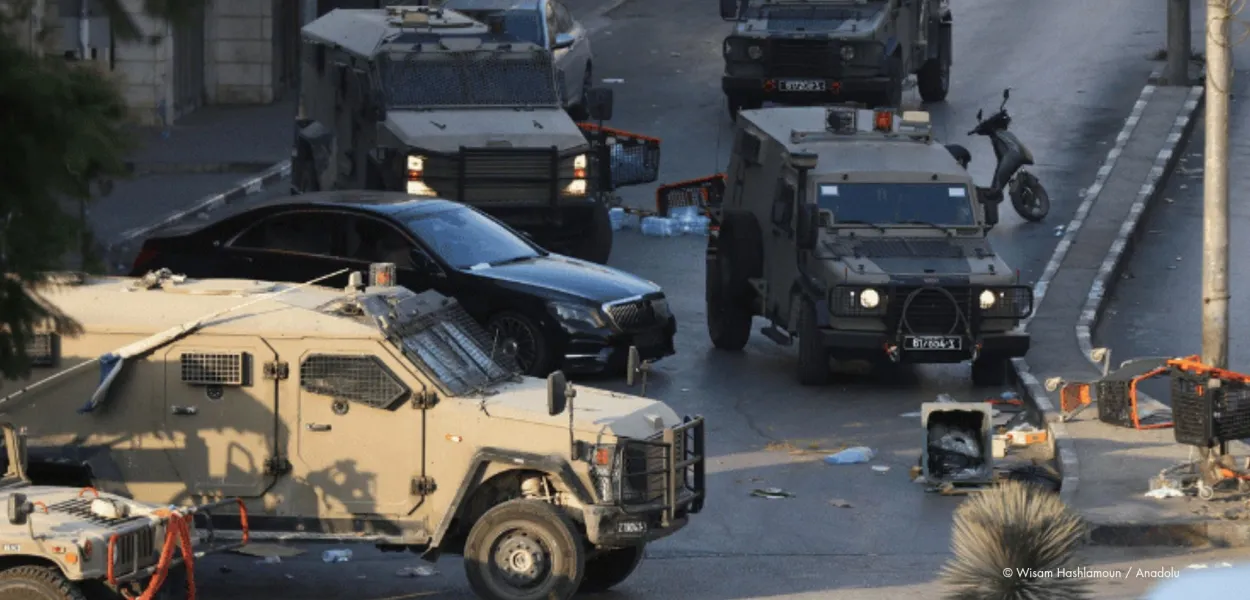
Israel must take immediate steps to end the apparent collective punishment of Palestinians in the West Bank. Following the killing of a pregnant Israeli woman by armed Palestinians on 14 May near Brukhin settlement, Salfit, Israeli security forces closed all entrances to the Palestinian villages of Kafr Al-Dik and Bruqin, placed all residents under curfew denying them access to supplies, schools and critical health services, carried out mass arrests accompanied by physical assault, and confiscated and damaged land and property including schools. On 15 May, an Israeli minister publicly called on Israel to “flatten” the two Palestinian communities and make them look like “Shja'iya and Tel Sultan” in Gaza.

Israeli settlers went on a rampage against Palestinian communities. During multiple attacks against Palestinians across the West Bank in the past days, which were often carried out in the presence of Israeli security forces, settlers reportedly set fire to at least one Palestinian home and 15 vehicles in Salfit governorate alone, threw stones and damaged several Palestinian vehicles on the Huwwara and Za’tara roads, Nablus, and raided Palestinian herding communities north of Jericho.

On 15 May, in the South Hebron Hills, settlers closed the northern entrance to Masafer Yatta for at least six hours, effectively blocking access to several villages, and on 19 May destroyed the wind turbine used to generate electricity in Qawawis, leaving the entire village without power.

According to information received by the UN Human Rights office OPT, on 18 May, after arresting several men in the town, Israeli security forces shot and killed a 36-year-old man from Bruqin. The deceased was reportedly arrested and detained for more than an hour before being killed while in IF custody, although ISF say that he was killed while running at them with an unidentified object. Israeli security forces is reportedly using as a military post the house where the killed man lived with his wife and children along with other homes in Bruqin.

In parallel, settler groups also called for revenge and escalated attacks against Palestinians, taking advantage of the situation to establish new outposts, in their continued efforts to forcibly displace increasing numbers of Palestinians and take over their land.

Since 16 May, Israeli bulldozers have been uprooting trees in the area in Bruqin after the Israeli army seized, under military orders, land belonging to the village, purportedly to improve security for settlers. On 19 May, the head of settlements regional council announced establishing an office in Bruqin, where groups of settlers have set up several tents and toilets, and called for demolition of Palestinian property and the establishment of a new settlement in the area. Also on 19 May,Israeli security forces demolished a three-story Palestinian home in the town, citing a lack of Israeli building permit.

In an another extremely concerning development, on 18 May, settlers brought dozens of sheep and started building animal pens and other structures for the establishment of a new outpost in close proximity to Palestinian homes in Mughayyir Al-Dir, Ramallah, with concerns that the move is aimed at forcibly displacing the last Palestinian herding community remaining in the area.

The Office is deeply concerned that such actions are directed at displacing Palestinians from their land and consolidating Israel's presence in and transfer of its population into the occupied territory. As the ICJ found in its Advisory Opinion in July last year, Israel is under an obligation to bring to an end its unlawful presence in the Occupied Palestinian Territory as rapidly as possible. It must cease immediately all new settlement activities and evacuate all settlers from the Occupied Palestinian Territory. 

16 May, 2025

Extrajudicial executions and other unlawful use of force in the occupied West Bank

The UN Human Rights Office in the Occupied Palestinian Territory calls for an end to the senseless killings in the occupied West Bank. Israel must stop all extrajudicial executions and other unlawful ...

The UN Human Rights Office in the Occupied Palestinian Territory calls for an end to the senseless killings in the occupied West Bank. Israel must stop all extrajudicial executions and other unlawful use of force in the occupied West Bank. Over the last two weeks, Israeli security forces have killed two Palestinian men in planned summary executions, while seven Palestinians were killed in conditions that raise concerns of the use of unnecessary or disproportionate lethal force. An Israeli woman was shot and killed on a highway in the occupied West Bank by as yet unidentified assailants. Israel must ensure that all those responsible for unlawful killings are brought to justice in fair trials.

On 8 May, Israeli undercover forces appear to have summarily executed a 30-year-old “wanted” Palestinian man in the old city of Nablus. CCTV footage suggests that an undercover officer killed the man while he tried to surrender and then shot him again as he lay on the ground injured and incapacitated, seemingly to “confirm the killing”. Claims from Israeli security forces that the man was armed and posing a threat to them appear to be contradicted by this video evidence. On 2 May, disguised Israeli security forces chased and killed a 39-year-old “wanted” Palestinian man in Balata refugee camp in Nablus. Although Israeli security forces claimed that they found a gun and cartridges in his car, they made no claim that he posed a threat to life at the moment he was shot. On 14 May, Israeli security forces reportedly fired live ammunition and injured a young Palestinian man in his thigh near the Qalandiya Refugee Camp, Jerusalem. A video shows two Israeli soldiers repeatedly kicking the man in the head, while he lay injured on the floor. The soldiers then walked away, without carrying out an arrest or providing medical assistance to the man who, in addition to live ammunition injury, reportedly incurred head hemorrhage due to the Israeli soldiers’ kicking.

Meanwhile, also on 15 May, armed Palestinians reportedly shot and killed a pregnant 30-year-old Israeli woman on the highway near Brukhin settlement, west of Salfit, also injuring her husband. Following the incident, Israeli security forces closed several checkpoints in the northern and central West Bank and imposed severe movement restrictions particularly around Burqin, and Salfit, while an Israeli minister called for “flattening” Palestinian villages in response. Israeli security forces must ensure that measures adopted following the attack complies with international law, including the prohibition of collective punishment. 

2 May, 2025

Alarm at displacement of Palestinians from northern West Bank refugee camps

We are alarmed at the rapidly increasing displacement of Palestinians and the destruction of homes in refugee camps in the northern West Bank. On 1 May alone, Israeli forces issued demolition notices ...

We are alarmed at the rapidly increasing displacement of Palestinians and the destruction of homes in refugee camps in the northern West Bank. On 1 May alone, Israeli forces issued demolition notices for 106 Palestinian-owned structures in Tulkarm camp and NurShams camp for "military purposes", ordering Palestinians to leave or file an objection within 24 hours. Tens of thousands of Palestinians remain forcibly displaced across the northern West Bank with little prospect of return, constituting mass forcible transfer. We are concerned that the additional demolitions are intended to force the displacement of Palestinians and are a form of collective punishment of the civilian population. A strengthened Israeli presence in the camps contravenes Israel’s legal obligation, affirmed by the ICJ, to end its unlawful presence in the OPT as rapidly as possible. 

21 March, 2025

Statement by the UN Human Rights Office in the Occupied Palestinian Territory on the developments in Gaza

The UN Human Rights office in the Occupied Palestinian Territory is horrified by the ongoing killing of hundreds of Palestinian civilians in Gaza since the resumption of large-scale Israeli bombardmen...

The UN Human Rights office in the Occupied Palestinian Territory is horrified by the ongoing killing of hundreds of Palestinian civilians in Gaza since the resumption of large-scale Israeli bombardment on 18 March. As of 20 March, at least 506 Palestinians were killed, including 200 children and at least 112 women according to the Palestinian Ministry of Health in Gaza.

Airstrikes and artillery shelling have struck homes, schools serving as shelters, and tents of internally displaced people — a pattern extensively documented by the UN Human Rights Office since October of 2023. The Israeli military appear to have resumed the practice of using explosive weapons with wide-area effects in densely populated areas. Across Gaza, since 18 March, the UN Human Rights office in the Occupied Palestinian Territory recorded at least three incidents where more than twenty fatalities were reported, and at least eight incidents with more than ten fatalities. Using explosive weapons with wide- area effects in such densely populated areas will almost certainly have indiscriminate effects and is very likely to be in violation of international humanitarian law rules on the conduct of hostilities.

Conducting hostilities using such means and methods in densely populated areas causes civilian casualties at a mass scale and is not consistent with Israel’s obligations under international humanitarian law, including abiding by the fundamental principles of distinction, proportionality, and precautions in attack.

On 20 March, Hamas’s military wing, Al Qassam Brigades, announced firing rockets on Tel Aviv. No casualties were reported. The targeting of civilians or launching of indiscriminate attacks amounts to a war crime.

Israel is again issuing forced displacement orders across Gaza and imposing severe movement restrictions. On 19 March, the Israeli military announced redeployment in Netzarim corridor which separates the north of Gaza from the south and prohibited Palestinians from moving through Salah Ad Deen road. The Israeli military ordered all Palestinians residing in areas located in the vicinity of the fence, described as “dangerous combat zones”, to leave to “known shelters” in western Gaza City and Khan Yunis.

The return of heavy bombardment and mass displacement orders indicates a resurgence of the pattern which has already forced 90 per cent of Palestinians in Gaza into displacement before the ceasefire, often more than once. The devastating impact of mass forced displacement will likely be exacerbated by Israel’s blocking of humanitarian aid, the already catastrophic shelter crisis in Gaza, and the lack of access to life- saving services.

Statements by the Israeli government further heighten fears about the deliberate flouting international law prohibitions and further collective punishment.

On the evening of 19 March, a statement by the Israeli Minister of Defence addressed to “residents of Gaza” threatened “significantly worse” strikes if hostages are not released and if Hamas is not expelled from Gaza, stressing that Gaza residents “will pay the price”. The statement referred to the “option” of “relocating to other parts of the world” if Palestinians “wish” to do so after the demands he outlined are met.

“The alternative”, the statement continued, “is utter destruction and devastation.”

Other statements by Israeli officials explicitly said that one of the goals of the renewed bombardment aims to “damage Hamas’s governmental capabilities” through targeting mid-level and senior-ranking members in Hamas’s Political Bureau, including officials in the civilian de-facto authorities— who, under international law, are civilians entitled to protection except if, and for such time, they directly participate in hostilities. Some civilian officials were reportedly killed with their entire families and children, including Ahmed Al Hatta, Undersecretary for the Ministry of Justice, who was killed with his wife and six children.

Violations by one party to the conflict never justify violations by the other. The targeting of civilians and civilian infrastructure across Gaza and any measures constituting forcible transfer of the civilian population or collective punishment are violations of international law and are war crimes.

The heightened Israeli siege since 2 March, which has prevented basic necessities from reaching civilians amounts to collective punishment. We recall that in its March 2024 binding order, the International Court of Justice unanimously ordered Israel to take all necessary and effective measures to ensure the unhindered provision at scale of urgently needed basic services and humanitarian assistance to Palestinians throughout Gaza, to conform with its obligations under the Convention on the Prevention and Punishment of the Crime of Genocide.

Israel is legally bound to immediately end and punish breaches of international law, and as the occupying power, to protect Palestinian civilians from violence, ensure the provision of all necessities of life, and ensure they can return to their homes in safety and dignity.

We repeat our call on member states to take decisive action to end hostilities in Gaza and ensure accountability for the grave breaches of international law committed over the past year and a half.