30 October, 2026

Displacement deepens as Israeli forces push Palestinians into shrinking space

Displacement deepens as Israeli forces push Palestinians into shrinking spaceConcerns of ethnic cleansing in Gaza endure as Israeli forces continue to push Palestinians into an ever-smaller fraction o...

Displacement deepens as Israeli forces push Palestinians into shrinking space

Concerns of ethnic cleansing in Gaza endure as Israeli forces continue to push Palestinians into an ever-smaller fraction of the territory, causing recurrent displacement while destroying the remaining civilian infrastructure and attacking displacement sites.

Palestinians in Gaza are surrounded by Israeli forces from all sides that continue to push them inwards with the stated aim of increasing the Israeli military deployment area to 70% of Gaza’s territory. The relentless contraction of space available to civilians comes with new displacement drivers in areas adjacent to Israeli forces’ deployment lines, commonly known as the “yellow line”.

Over the past two weeks, the UN Human Rights Office in the Occupied Palestinian Territory has documented the westward expansion of Israeli military deployment areas triggering new displacement of Palestinians in Al Shujaiyeh, Gaza City, and in eastern Al Bureij, eastern Deir al Balah and eastern Al Maghazi, Middle Gaza. In Al Shujaiyeh, Israeli forces’ westward push came with at least two Israeli attacks reported on displacement encampments, and detonations of the few buildings left standing in the area with the reported use of explosive robots.

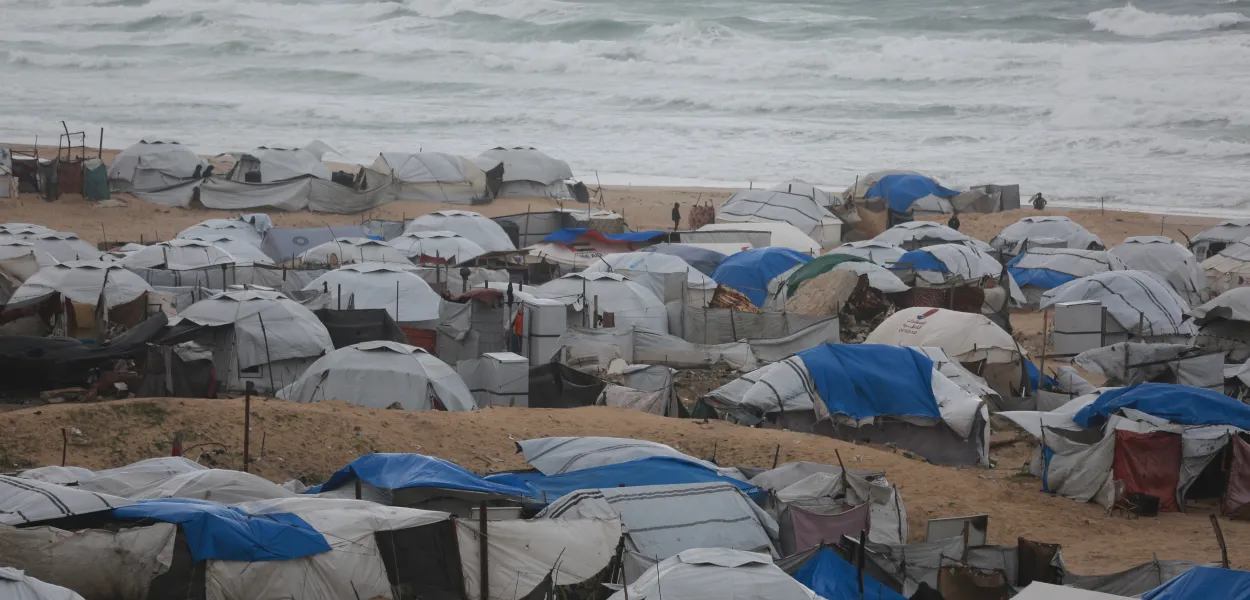
According to reports received by UN Human Rights Office - OPT, an Israeli drone dropped munitions on tents sheltering displaced families at Al Shujaiyeh junction near the so-called yellow line on 25 October, setting tents on fire burnt for nearly five hours. The Palestinian Ministry of Public Works and Housing in Gaza said the fire displaced 200 families comprising 800 people, most of them women, children and elderly persons.

“The nightmare of displacement in Gaza is both acute and chronic,” said Ajith Sunghay, Head of UN Human Rights - OPT. “Those displaced before the announcement of a ceasefire have little to no prospect of return to the areas they fled, most of which are inaccessible because they fall beyond the so-called yellow line. And they continue to be displaced again and again.”

As an occupying power, Israel must cease the forcible transfer of Palestinians within the Gaza strip, a war crime that may also amount to a crime against humanity. Israel must facilitate the Palestinians’ safe and dignified return to their homes and the areas they fled. Instead, Israeli military operations have displaced nearly everyone in Gaza multiple times, laid to waste the infrastructure needed to support civilian life, and damaged or destroyed over 80% of all buildings and structures according to the United Nations Satellite Centre.

Today, Israeli forces appear to treat the yellow line as a kill zone, preventing Palestinians from returning to what is left of their homes on the other side. The displacement crisis is exacerbated by the restrictions imposed by Israeli authorities on the entry of shelter-related humanitarian assistance. And Israeli bombardment never ceased, even a year after the announcement of a ceasefire, while Palestinian families remained trapped in inadequate shelters, struggling to secure their most basic needs and deprived of their rights.

“There must be an end to this suffering. This is the fourth year of displacement for most Palestinians in Gaza, the fourth winter in tents too flimsy to withstand the rain, and they are still under fire through it all,” said Sunghay. “Let this be the last.”

23 January, 2026

Gaza: Civilian killings continue after ceasefire

UN Human Rights in the Occupied Palestinian Territory (OPT) is horrified by the continued killing of civilians in Israeli attacks in Gaza including at least 11 Palestinians killed in a series of attac...

UN Human Rights in the Occupied Palestinian Territory (OPT) is horrified by the continued killing of civilians in Israeli attacks in Gaza including at least 11 Palestinians killed in a series of attacks on 21 January, amid a broader pattern of post-ceasefire violence and the enduring effects of two years of devastation.

The 21 January attacks included an Israeli strike on a car which killed three Palestinian journalists near Netzarim area in central Gaza after conducting a photography assignment for the Egyptian Relief Committee. The killing of Anas Ghneim, Abdel Raof Shaat, and Muhammad Salah Qishta brings the number of journalists killed in Israeli attacks since 7 October 2023 to 292, as verified by UN Human Rights in OPT.

Israeli ground forces reportedly opened fire and carried out artillery shelling in three incidents on 21 January in the vicinity of their deployment line, known as the “yellow line”, which remains not clearly marked on the ground. The attacks reportedly killed a 13-year-old boy east of Khan Younis, and three family members including a father and his 13-year-old son in Middle Gaza. Israeli shelling also reportedly killed three Palestinian brothers northeast of Al Bureij camp in Middle Gaza.

Trends documented by UN Human Rights in the OPT since the ceasefire came into effect on 11 October 2025 include the continued killing of civilians in Israeli aerial attacks, shelling, and gunfire across all five governorates of Gaza, including incidents both far from and in the vicinity of the “yellow line”. Overall, 477 Palestinians were reportedly killed in Israeli attacks in Gaza since the ceasefire according to the Palestinian Ministry of Health, most appear to be civilian.

Since the ceasefire until 21 January 2026, UN Human Rights in the OPT recorded the killing of at least 216 Palestinians, including at least 46 children and 28 women, in Israeli attacks far from the so-called “yellow line”, mainly on shelters of internally displaced persons and residential buildings. This included 126 reported attacks by Israeli unmanned aerial vehicles (UAV) across Gaza resulting in the killing of at least 87 Palestinians, including 12 children and seven women.

In the same period, at least 167 Palestinians were reportedly killed in the vicinity of the “yellow line”, including 26 children and 17 women. Repeated Israeli military operations into areas west of the redeployment line have also led to the displacement of civilians and the demolition of residential buildings in those areas.

More civilians are dying due to the dire human-made humanitarian conditions, including at least nine children who died of hypothermia since the ceasefire.

UN Human Rights in the OPT has also recorded at least 80 reported killings of Palestinians by Hamas since the ceasefire, mostly in clashes with rival families and in summary executions. Hamas must respect international human rights law protections of persons under its control and must prevent and repress any violation of these rights committed by its members.

The persistent stream of civilian casualties raises concern that the Israeli military continues to disregard its obligations under international humanitarian law and international human rights law, including the right to life. The killings around the so-called “yellow line” also appear to involve the targeting of civilians not directly participating in hostilities on the sole basis of their proximity to deployment lines, which would constitute a war crime.

“The crisis in Gaza is nowhere near over. People are dying every day, both in Israeli attacks and as a result of continued Israeli restrictions on the entry of humanitarian assistance, in particular shelter, leading to deaths from the cold and under collapsing buildings. Palestinian journalists are killed, and international journalists are still barred from entering Gaza,” said Ajith Sunghay, Head of UN Human Rights in the OPT.

“This is a time for the international community to intensify support and pressure to stop the bloodshed and advance a rights-based approach to recovery and reconstruction.”

4 April, 2025

Alarm over killings and unlawful use of force by local police in Gaza amidst deteriorating public order

The UN Human Rights Office is alarmed by the breakdown of public order in Gaza, with recent allegations of killings and unnecessary or disproportionate use of force in crowd control by local police. T...

The UN Human Rights Office is alarmed by the breakdown of public order in Gaza, with recent allegations of killings and unnecessary or disproportionate use of force in crowd control by local police. The siege of Gaza has now entered its second month as the humanitarian situation grows even more dire.

Israel’s continued attacks on Gaza have served to dismantle and destroy Gaza’s governance and law enforcement structures, contributing to a deterioration of public order that threatens the safety of Palestinians and their access to basic services and life-saving humanitarian aid. The situation is further exacerbated by Israel’s complete closure of crossings into Gaza, preventing entry of any goods or essential supplies as families struggle to find the basic necessities such as food and water.

As vital aid becomes scarcer and people become more desperate, our Office has received reports of several incidents alleging the unnecessary or disproportionate use of force by local police against crowds seeking food. On 1 April, a Palestinian police officer allegedly discharged his firearm while attempting to control a crowd at a flour shop in Deir al Balah, killing a Palestinian man. Later, the family of the victim reportedly apprehended and killed the unarmed police officer in broad daylight. On 2 April, in a similar incident, local security personnel reportedly shot and killed a Palestinian man while managing aid distribution to a crowd at a warehouse in At Tuffah, Gaza City.

Of further concern are allegations of the arbitrary detention, torture and killing of a young Palestinian man, raising concerns of extrajudicial execution. On 28 March, armed Palestinian men reportedly took the victim from his shelter in Tal al Hawa in Gaza City, allegedly because of his participation in demonstrations criticizing Hamas and calling for an end to the war that took place in several locations in Gaza between 25 and 27 March. A few hours later, the family found him stripped, handcuffed, blindfolded, and beaten with a rope around his neck in front of a hospital in the neighbourhood. He succumbed to his injuries shortly afterwards. There are also reports that other individuals have been summoned by the local de facto authorities on account of their participation in the demonstrations.

Such killings and the use of excessive force in civilian crowd control and undue restrictions on the freedoms of peaceful assembly and expression, including arbitrary detention, ill-treatment and torture are unacceptable. While recognizing the challenges faced by the law enforcement system in Gaza, due to the systematic destruction by Israel, we remind any remaining de facto authorities including local law enforcement in Gaza of their obligation to comply with international human rights law standards on the use of force, including in crowd control, and underscore the need for prompt and effective investigations into any allegation of unlawful killings and other violations of human rights law. We further urge Israel to immediately fulfil its obligations by taking all feasible steps to ensure public order and civil life in Gaza, in particular by respecting, protecting and ensuring the human rights of the population, including by immediately facilitating the entry of aid and assistance and refraining from attacking Gaza’s justice and civilian law enforcement systems. 

18 March, 2025

Annexation, violence, and forced displacement must stop immediately- Ajith Sunghay, Head of the UN Human Rights Office in the Occupied Palestinian Territory

Remarks to the press- as deliveredBefore speaking to you today about our latest report on the occupied West Bank, I would like to start with the tragic developments overnight in Gaza, where we are hea...

Remarks to the press- as delivered

Before speaking to you today about our latest report on the occupied West Bank, I would like to start with the tragic developments overnight in Gaza, where we are hearing reports of hundreds being killed, many of them civilians, in a wave of Israeli strikes.

According to the Ministry of Health in Gaza, 326 Palestinians were killed, including many women and children. The Israeli military had already killed at least 106 Palestinians since the ceasefire started in January up to last night, mostly in and around “no-go” zones along the edges of Gaza.

The Israeli military reportedly hit residential buildings, schools and IDP camps - a trend that has been documented extensively by our Office since October 2023. We are again seeing the scenes of mutilated bodies of children, and bodies wrapped in shrouds. The Israeli military also issued a displacement order from several parts of Gaza- indicating a return to a pattern which led to the forced displacement of 90 per cent of the Palestinian population in Gaza, often several times. It is unacceptable, even unimaginable, to once again find ourselves talking about this instead of supporting a path towards meaningful recovery and sustainable peace.

The situation is compounded by the blockade on Gaza. For over two weeks now, Israel has closed all crossings and prevented the entry of humanitarian aid, fuel, and all other supplies. We are also concerned about reported plans to cut off the little that remains of the water supply. With no fuel, no electricity, and no aid, how can bakeries, water desalination plants, and other critical infrastructure operate? How long before all food runs out and we’re again facing hunger and starvation?

We once again remind Israel of its obligation to comply with international humanitarian law’s fundamental principles of distinction, proportionality and precautions in attack. Any targeting of civilians not directly participating in hostilities is a war crime and must stop, immediately; the blockade of Gaza amounts to collective punishment and must stop, immediately; and the use of starvation as a weapon of war is a crime under international law.

Simply, this violence, and the killing must stop immediately. The hostages must be released. Those arbitrarily detained must also be freed.

Now to the report we are putting before you today, which points to another deeply concerning trajectory taking place in the West Bank, including East Jerusalem. Israel is taking serious and accelerated steps to annex more and more parts of the Occupied Palestinian Territory in violation of international law.

In the West Bank, settlements are expanding at an alarming rate. This is coinciding with a series of legislative and policy steps that are increasingly allowing for land appropriation from Palestinians and further facilitating the extension of Israeli sovereignty and laws over the West Bank.

The rampant forcible displacement of Palestinians from their homes and lands in the West Bank further exacerbates the situation. We are witnessing a violent and ever-expanding Israeli operation that started last January in the northern parts of the West Bank, particularly Jenin, Tulkarem and Tubas. This operation has so far killed 59 Palestinians, displaced tens of thousands, and emptied entire refugee camps.

Displacement is further fueled by continuously increasing home demolitions and evictions, settler violence that can no longer be separated from state violence, and daily appropriation of Palestinian land on alleged “security grounds” only to be later allocated to serve settlers.

We have a clear legal pathway to follow here, confirmed last year by the International Court of Justice. The occupation of the Palestinian territory must end as rapidly as possible, all Israeli settlers must be evacuated, and all settlement of this territory must cease immediately. The international community has a strong mandate to take meaningful action to prevent annexation and ensure Palestinians’ right to self-determination. Member States must act now.