10 October, 2026

One year after ceasefire announcement, killings continue across Gaza

A year after the announcement of a ceasefire in Gaza, Palestinians are still living under constant Israeli fire in attacks both near and far from the so-called “yellow line” that raise serious concern...

A year after the announcement of a ceasefire in Gaza, Palestinians are still living under constant Israeli fire in attacks both near and far from the so-called “yellow line” that raise serious concerns about continued crimes under international law, including war crimes.

“This is not life; this is endless torment with no end in sight. Human life has no value anymore,” said one father of three in Gaza. “There is not a single thing I can think of to ensure my children will survive from one minute to the next. We are constantly at the mercy of a random bullet, shelling, or an aerial attack. Sometimes it feels like they are playing games with our lives.”

Throughout the past year, Israeli attacks never ceased, killing and injuring Palestinians and causing recurrent displacement across Gaza. Over 1,400 Palestinians have been killed in Gaza according to the Palestinian Ministry of Health since the announcement of a ceasefire on 10 October 2025. UN Human Rights – OPT has so far verified1,076 conflict-related deaths between the ceasefire announcement and the end of July 2026, including 268 children, 126 women, and 682 men — women and children making up 37 per cent of all verified fatalities.

Since 7 October 2023, Israeli forces have killed over 20,000 children in Gaza, according to the Palestinian Ministry of Health. Since the announcement of a ceasefire in October 2025, UN Human Rights – OPT has verified the killing of 64 children in reported Israeli attacks that killed only children and no adults. This is in addition to 30 women and 10 more children killed in reported Israeli attacks in which all those killed were women or women and children with no men fatalities. The total proportion of civilian fatalities is likely much higher, as this number does not take into account all the civilian men killed in Gaza.
This pattern raises serious concerns that Israel is directing attacks against civilians not directly participating in hostilities — a war crime.

“Violence of this magnitude is outrageous at any time. To record it during a supposed ceasefire is simply unfathomable,” said Ajith Sunghay, Head of UN Human Rights – OPT. “Palestinians have endured these attacks while trapped within an ever-shrinking part of Gaza’s territory, surrounded from all sides by Israeli forces, and struggling to secure even the most basic necessities of life.”

The Israeli military has consistently expanded its deployment areas starting from nearly 53 per cent of Gaza’s territory at the time of the ceasefire announcement, with the objective of reaching 70 per cent of the territory as publicly stated by the Israeli Prime Minister. The boundary of these deployment areas has been commonly known as the “yellow line”, but monitoring over the past year demonstrates there is no single, identifiable line. Instead, Israeli forces continuously moved inwards, along ever-shifting lines not known to Palestinians, with frequent incursions into Palestinian communities.

While most verified fatalities have been recorded in reported Israeli attacks far away from Israeli military deployment areas, the conduct of Israeli forces around the so-called yellow lines raises serious concerns that it is being treated as a kill zone where lethal force is arbitrarily used.

A two-year-old boy was shot and killed in the early morning hours of 14 June 2026 in the arms of his father on their way to visit an aunt in Wadi Al Salqa, eastern Deir Al Balah. They were on a road approximately 150-200 meters west of the so-called “yellow line”, used routinely by Palestinians before the incident. On the way, the father saw a group of Israeli soldiers stationed at the entrance of an abandoned house in an apparent incursion west of the line. The soldiers were only 10 meters away, he told UN Human Rights – OPT, and they started shooting immediately.

“I saw my boy’s left eye come out of his face,” the father said. “As I realized a bullet penetrated his back and came out from his eye, another bullet struck me in the calf. I saw a bone fragment shoot out of my leg and land on the ground in front of me. I fell to the ground. My son was gasping for his last breath. I tightened my arms around him.”

The boy was taken away by soldiers, his father said, wrapped in a plastic sheet, “no longer moving or making any sounds”. The father was then stripped down, blindfolded, and dragged east, crossing the yellow line. Israeli soldiers moved him from vehicle to vehicle and from one site to another until he passed out from the bleeding around midnight.

“I woke up in Al Aqsa Martyrs Hospital in Deir Al Balah. I was informed that my son’s body was handed over as well. I do not know how and when we got there,” the father said.

Since the announcement of a ceasefire in October 2025, as of the end of July 2026, 331 Palestinians have been killed in the vicinity of the so-called yellow line as verified by UN Human Rights – OPT, including 66 children, 27 women, and 238 men. In many verified cases, there was no information to suggest the victims were posing any threat to Israeli forces. Many were carrying out ordinary civilian activities at the time of their killing, and some were killed while inside their tents. Targeting and killing civilians who are not directly participating in hostilities is a war crime regardless of their location or proximity to military deployment areas.


Sunghay reiterated UN Human Rights’ calls on third States to implement their duty to exercise influence over Israel to stop its violations of international law in Gaza, including by ceasing the supply of weapons and munitions facilitating serious violations of international law, and supporting the work of international accountability mechanisms.

“Accountability is not an afterthought or part of a distant future of recovery. It is a cornerstone of deterrence and non-recurrence. And it is already overdue,” he said.

3 September, 2026

Israeli forces killed two boys in Al Mughayyir

Israeli forces shot and killed two Palestinian boys,16-year-old Khalil Shihadeh and 17-year-old Omar Al Nassaan, in Al Mughayyir during a reported settler attack. Israeli forces and settlers have now ...

Israeli forces shot and killed two Palestinian boys,16-year-old Khalil Shihadeh and 17-year-old Omar Al Nassaan, in Al Mughayyir during a reported settler attack. Israeli forces and settlers have now killed 9 Palestinians in the town since December 2024, including 5 boys.  

Surrounded by 8 settler outposts, Al Mughayyir has been a target for incessant settler and state violence to force Palestinian residents to leave. This included more than 50 settler attacks in 2026 alone, according to OCHA, with an average of 7 attacks per month, with the acquiescence, support, and participation of Israeli forces. 

While outposts expand around Al Mughayyir, settler and state violence has already purged entire surrounding communities of Palestinians, including the villages of Ein ar Rashash, Ras al Tin, and Ein Samya. 

Israel must meet its international law obligation to end its unlawful presence and evacuate all settlers from the occupied West Bank.

3 September, 2026

Bloodshed in Gaza must come to an end

Almost a year since a ceasefire was announced and nowhere and nobody in Gaza is safe. Twenty-four Palestinians have been killed in Israeli attacks in the five days between 28 August and 1 September, i...

Almost a year since a ceasefire was announced and nowhere and nobody in Gaza is safe. Twenty-four Palestinians have been killed in Israeli attacks in the five days between 28 August and 1 September, including four children and a woman. Twenty-one were killed in airstrikes.

Palestinian armed elements’ operations with the reported support of Israeli forces are causing civilian harm. On 1 September, according to initial information, the Israeli military conducted a raid into Al-Katiba area in West Gaza city accompanied by Palestinian armed elements under the cover of multiple airstrikes, killing a 3-year-old girl and a 13-year-old boy, and a 31-year-old man.
The fourth victim was a 49-year-old woman, the wife of 51-year-old Moein Al Arbeed, a colonel with the de-facto Internal Security Agency who has been detained by Israeli forces during the raid.

Israel’s stated pursuit of individuals that it alleges to be lawful targets does not suspend its international humanitarian law or international human rights law obligations, including in relation to Palestinians’ right to life. Nor does it justify the daily terror Palestinians are subjected to in Gaza. This bloodshed must finally come to an end. There must be justice and accountability for all the unlawful killings and other violations in Gaza.

6 July, 2026

Four-month-old dies at Israeli gate west of Ramallah

Four-month-old Ahmed Marouf Zaid died yesterday after Israeli soldiers refused to open a gate blocking the main entrance to his village west of Ramallah, delaying his access to urgent medical care. An...

Four-month-old Ahmed Marouf Zaid died yesterday after Israeli soldiers refused to open a gate blocking the main entrance to his village west of Ramallah, delaying his access to urgent medical care. An ambulance was waiting on the other side.

"Last month, 7-month-old Sam Abu Haykal was shot and killed by an Israeli soldier at a checkpoint. Yesterday, a critically ill 4-month-old was forced to wait for urgent medical care just steps from an ambulance. Both deaths are senseless, and both are emblematic of an occupying power continuing to show utter disregard for the humanity and rights of Palestinians living under occupation," said Ajith Sunghay, Head of UN Human Rights in the Occupied Palestinian Territory.

According to OCHA, road gates like the one closed to Ahmed’s family make up 41% of the 925 Israeli movement obstacles that permanently or intermittently restrict the movement of 3.4 million Palestinians across the occupied West Bank.

18 June, 2026

Fatalities since ceasefire announcement in Gaza

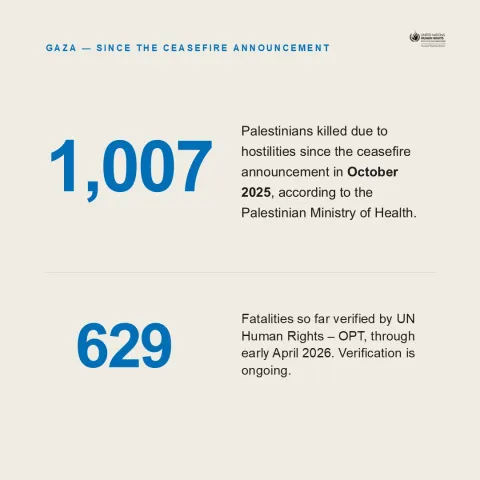
More than 1,000 Palestinians killed in Gaza since the announcement of a ceasefire in October 2025. Here is what we know:  269 women and children among the 629 fatalities verified by UN Human Righ...

More than 1,000 Palestinians killed in Gaza since the announcement of a ceasefire in October 2025. Here is what we know:

Image
1,007 killed according to MOH, 629 verified killed so far

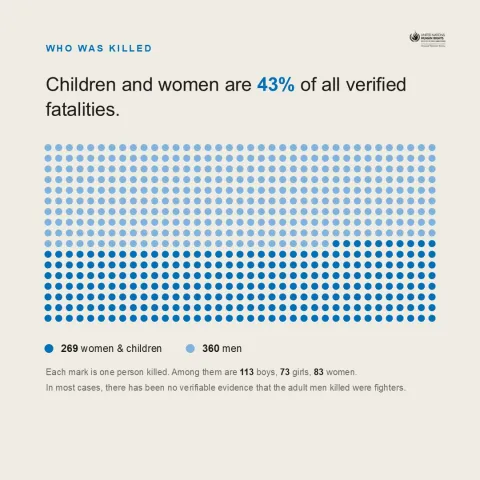
269 women and children among the 629 fatalities verified by UN Human Rights - Palestine in Gaza since the announcement of a ceasefire in October 2025 through early April, verification is ongoing.

Image
269 women and children among 629 verified fatalities

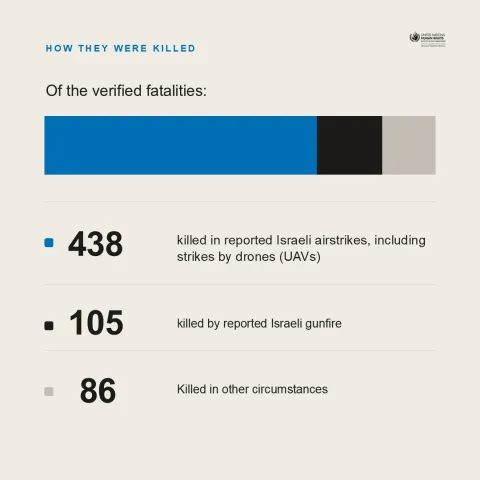
438 of the 629 verified fatalities since the announcement of a ceasefire in Gaza were killed in reported Israeli airstrikes, including strikes by unmanned aerial vehicles (UAVs).
 

Image
Breakdown of fatalities by reported means of killing

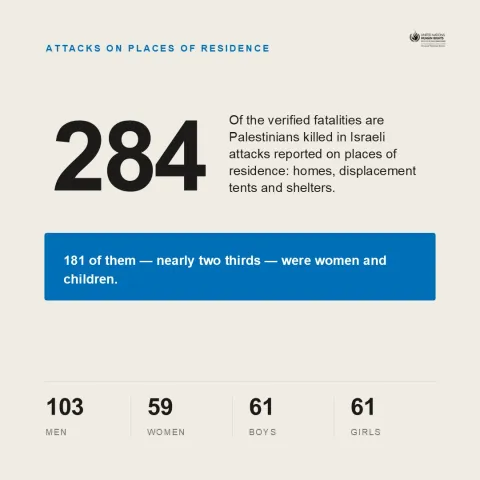
284 of the 629 fatalities verified by UN Human Rights - Palestine in Gaza since the ceasefire announcement were killed in their homes, tents, or shelters.

Image
284 killed in homes or shelters

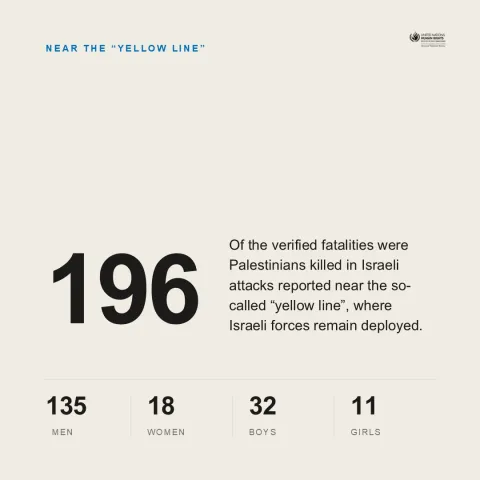
196 Palestinians were killed in Israeli attacks reported near the so-called "yellow line" out of the 629 fatalities verified by UN Human Rights - Palestine since the ceasefire announcement through early April.

Image
196 killings in the vicinity of the so-called yellow line

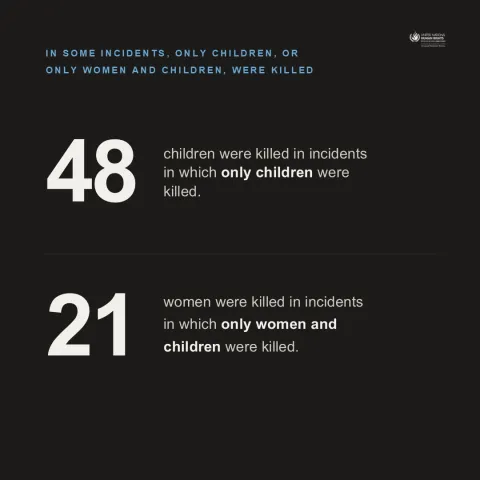
Since the ceasefire announcement in Gaza in October 2025, some incidents only killed children, or only killed women and children. 

Image
48 children killed in attacks whose victims were all children
12 June, 2026

Surviving childhood under occupation - The catastrophic harm facing Palestinian children

Surviving childhood under occupation - The catastrophic harm facing Palestinian childrenIsraeli violence is subjecting Palestinian children to catastrophic levels of harm: killed, maimed, displaced, a...

Surviving childhood under occupation - The catastrophic harm facing Palestinian children

Israeli violence is subjecting Palestinian children to catastrophic levels of harm: killed, maimed, displaced, and living in perpetual insecurity.

On Saturday, 6 June 2026, Israeli security forces shot and killed 7-month-old Sam Fahed Abu Haykal in his parents’ car near a Hebron checkpoint. The bullet appears to have passed through Sam’s head and injured both his parents. Video footage analysed by an Israeli human rights organisation shows a member of the Israeli security forces shooting at the car as it was slowing down, posing no threat, and clearly indicates that he provided no aid to the family afterwards.

Sam is one of 241 children killed by Israeli security forces and settlers in the occupied West Bank since 7 October 2023, as verified by the UN Human Rights in the Occupied Palestinian Territory (OHCHR OPT). This is in addition to over 21,000 children who have been killed in Israeli attacks in Gaza in the same period, according to the Palestinian Ministry of Health, with killings continuing after the announcement of a ceasefire in October 2025.

Since the ceasefire announcement, the Palestinian Ministry of Health has reported the killing of 981 Palestinians in Israeli attacks in Gaza. OHCHR OPT has so far verified the killing of 574 Palestinians during this period, including 183 children, five of whom were infants under the age of one.

On 4 February 2026, Israeli forces opened fire on an encampment for displaced people in Al Tuffah, Gaza City, killing five Palestinians, including two women and two baby girls: 5-month-old Mira Al Khabbaz and Watein Al Khabbaz, born less than a week before.

Forty-eight of the 183 verified child fatalities after the ceasefire announcement were victims of incidents in which only children were killed, raising concerns about Israeli forces directly targeting Palestinian children. Fifteen women have also been killed in incidents in which only women, or only women and children, were killed.

On 29 October 2025, an Israeli airstrike hit a tent housing displaced people in Al Mawasi, Khan Younis, and killed three Palestinians: two brothers aged eight and 11, and their 15-year-old sister. On 31 January 2026, an Israeli strike hit a residential building in western Gaza City, killing two women aged 60 and 23, and three sisters aged five, seven and nine. On 2 February 2026, Israeli Naval Forces killed one Palestinian, a 2-year-old boy, in his tent on the coast of Al Mawasi, Khan Younis.

In the West Bank, the 241 verified child fatalities represent nearly one in five of the 1,103 Palestinian victims killed by Israeli security forces and settlers since 7 October 2023.

In March 2026, three months before the shooting that killed 7-month-old Sam in Hebron, a similar attack in Tammun, south of Tubas, killed four family members in their car. At the time, Israeli security forces opened fire on a Palestinian vehicle, killing a father, Ali Bani Odeh, a mother, Wa’ad Bani Odeh, and their 5- and 6-year-old sons, Mohammad and Othman. Two children survived the shooting, aged eight and 11, but later reported that they were assaulted by Israeli security forces when they left the car.

Most of the children killed in the West Bank are teenage boys, 213 out of 241. In many cases, subsequent statements by Israeli authorities accuse the children of having engaged in stone-throwing as a justification. In all OHCHR OPT-verified killings of minors involved in confrontations with Israeli security forces, our assessment is that none posed an imminent threat to life —the only legal justification for the use of lethal force in the occupied West Bank under international law. Where less harmful means were available, such lethal force may constitute an arbitrary deprivation of life and, in the context of occupation, may amount to willful killing, a war crime.

On 20 December 2025, a member of Israeli security forces hiding behind a wall shot and killed 16-year-old Rayan Abu Mulla in Qabatiya, south of Jenin, on his way home. An official Israeli statement claimed Rayan was throwing stones. However, according to witnesses and CCTV footage, he was walking empty-handed. Israeli security forces also prevented ambulances from assisting Rayan. They then took his body away and refused to hand it over for burial.

OHCHR OPT’s analysis demonstrates a pattern of Israeli security forces preventing medical assistance to injured Palestinians and withholding bodies, including those of children.

Children are civilians and have special protections under international humanitarian law and international human rights law. The routine assault on their right to life, safety, and liberty in the Occupied Palestinian Territory at this massive scale points to war crimes.

“From newborns to teenagers, Palestinian children have not been spared extraordinary levels of Israeli violence. The pattern, at a minimum, shows a dangerous scale of dehumanisation and disregard for Palestinian lives,” said Ajith Sunghay, Head of UN Human Rights in the Occupied Palestinian Territory. “Palestinian children must be able to grow up in safety, with the same rights and protections as children anywhere else in the world. Surviving childhood should never be this difficult.”

29 May, 2026

Attacks on Gaza over Eid kill 26, as Israeli forces push deeper into the strip

Attacks on Gaza over Eid kill 26, as Israeli forces push deeper into the stripUN Human Rights in the Occupied Palestinian Territory (OHCHR OPT) condemns the increase in Israeli attacks in Gaza since t...

Attacks on Gaza over Eid kill 26, as Israeli forces push deeper into the strip

UN Human Rights in the Occupied Palestinian Territory (OHCHR OPT) condemns the increase in Israeli attacks in Gaza since the eve of Eid Al Adha on Tuesday, 26 May. At least 26 Palestinians were killed since Tuesday including six women and seven children as Palestinian families prepared to observe Eid amid displacement, deprivation, and insecurity.

Three airstrikes on 26 May killed 12 Palestinians. In the early morning hours, one more 14-year-old girl died of injuries sustained in an Israeli airstrike the day before that also killed a 30-year-old woman and a five-year-old girl according to initial information. Since the announcement of a ceasefire, at least 32 children and eight women have been killed in Israeli attacks in which fatalities were exclusively women and children.

One of the airstrikes on 26 May killed four men in eastern Al Maghazi camp, Middle Gaza, reportedly after they resisted attempts to search their homes by armed gangs allegedly supported by the Israeli military. Another airstrike hit a car in Al Mawasi, Khan Younis, killing two men. The third airstrike struck an apartment in Al Rimal, Gaza City, and killed a newly appointed commander of Hamas’s Al Qassam Brigades together with his wife, his two sons, aged 15 and 22, his daughter, aged 9, and a woman passerby.

On the first day of Eid Al Adha, 27 May, an Israeli airstrike in central Gaza City reportedly killed at least ten: four girls, one boy, three women, and two men allegedly affiliated with Al Qassam Brigades.

Since the announcement of a ceasefire, Israeli forces have killed 922 Palestinians in attacks across Gaza, bringing the total death toll since 7 October 2023 to nearly 73,000.

OHCHR OPT has consistently warned that Israel’s attacks in Gaza violate international humanitarian law’s principles of distinction, proportionality, and precaution in attacks. A recent OHCHR OPT report also concluded that the totality of Israeli conduct in Gaza raises serious concerns about Israel’s compliance with its obligations to prevent acts prohibited under the Genocide Convention.

The Israeli blockade on Gaza is also still depriving Palestinians of necessities, including adequate shelter, essential medicines, and food items. Almost everyone is displaced and concentrated into less than half the land area of Gaza— hemmed in by Israeli ground forces that continue to move west, displacing families and pushing them into a progressively narrower strip of land. In recent days, multiple displacement orders were issued, forcing people out of their shelters. The Israeli Prime Minister announced yesterday that he had directed Israeli forces to expand their deployment to cover 70 per cent of Gaza. The continued contraction of areas available to civilians raises grave concerns about access to humanitarian assistance, and the ability of displaced families to find any meaningful safety.

“Our concerns about the commission of war crimes in Gaza have not stopped,” said Ajith Sunghay, Head of UN Human Rights in the Occupied Palestinian Territory. “It is difficult enough to navigate life in chronic displacement in the ruins of Gaza, under blockade, and after Israeli attacks virtually destroyed every essential system: healthcare, education, food production, law enforcement and civil order. Continuing military attacks on a population living under these conditions is unthinkable.”

23 April, 2026

Child and man killed near school in Al Mughayyir as settler militarization intensifies

Child and man killed near school in Al Mughayyir as settler militarization intensifiesUN Human Rights in the Occupied Palestinian Territory (OHCHR OPT) condemns the killing of 14-year-old Aws Hamdi Na...

Child and man killed near school in Al Mughayyir as settler militarization intensifies

UN Human Rights in the Occupied Palestinian Territory (OHCHR OPT) condemns the killing of 14-year-old Aws Hamdi Naasan and 35-year-old Jihad Abu Naiem by Israeli settlers on 21 April in Al Mughayyir village in the occupied West Bank. It also condemns the killing of 25-year-old Odeh Awawdeh in a separate settler attack in Deir Dibwan, east of Ramallah. The killings continue a growing pattern of unchecked violence by a settler movement that is militarized and shielded by the state.

In Deir Dibwan, settlers entered the village and clashed with residents with an armed settler shooting and killing 25-year-old Odeh Awawdeh. Israeli security forces raided the town and closed its entrances during the incident, detaining 30 Palestinian men who were later released. According to Israeli media reports, Israeli security forces also held several settlers for questioning following the incident.

Settlers also attacked Al Mughayyir around noon on Tuesday and opened fire towards the boys’ school west of the village. Residents of Al Mughayyir circulated a video showing the shooting of the child while sheltering with others just outside his school as gunshots are heard from a distance. Eyewitnesses told OHCHR OPT that one of two armed settlers in partial uniform was shooting at the school, with four masked members of Israeli security forces in full uniform present at the scene.

The Israeli military issued a statement claiming that the incident occurred when a car carrying “civilians including a reservist soldier” stopped when stones were allegedly hurled. The statement said the reservist exited the vehicle and shot at suspects. According to Israeli media, the reservist was later suspended and an investigation was initiated.

At least nine Palestinians have been killed since the beginning of 2026 by settlers later identified by the Israeli military as reservist soldiers.

This convergence of settler and soldier is the result of measures taken by the Israeli authorities to intensify the militarization of the settler movement since 7 October 2023, including the enlistment and arming of thousands of settlers as reservists in regional battalions known as Hagmar. These measures also include arming and empowering settlements’ emergency response squads known as Kitat Konenut, and the relaxation of gun licensing requirements for Israelis, including settlers.

Across the West Bank, Palestinians are reporting attacks by men who are clearly known to them as settlers, but who are dressed in full or partial military uniform and are often carrying state-issued assault rifles and military gear. Palestinian survivors of such attacks describe their attackers as “settlers in uniform.”

Settler attacks on Palestinian communities are often carried out with the active support and participation of uniformed Israeli security forces, even when there is no ambiguity that the perpetrators are settlers.

Since 7 October 2023, 1,088 Palestinians have been killed by Israeli security forces and settlers in the occupied West Bank, including 238 children. This includes 34 by settlers, 1,040 by Israeli security forces, and 14 Palestinians whose killings cannot be definitively attributed because Israeli security forces and settlers were attacking and shooting together.

No Israeli soldier has served a single day in prison for killing a Palestinian in the occupied West Bank since at least 2017. The only recorded conviction was in 2020 for which the sentence was three months of military service and three months of suspended jail time.

Settlers’ impunity is equally systematic. According to the Israeli human rights organization Yesh Din, 93.6% of all investigations of settler violence in the occupied West Bank between 2005 and 2025 were closed without indictments, and only 3% led to partial or full convictions with lenient sentences.

“Israeli policies have erased whatever line that ever existed between settler and state violence. And the systematic impunity for killing Palestinians is the backbone of this non-stop horror,” said Ajith Sunghay, head of OHCHR OPT. “The international community must insist on meaningful accountability for the perpetrators of all unlawful killings in the Occupied Palestinian Territory to stop the bloodshed.”

30 March, 2026

International Women's Day - Remarks by Ajith Sunghay, Head of UN Human Rights - Palestine

Remarks by Ajith Sunghay, Head of UN Human Rights - PalestineInternational Women's Day- closing eventExcellency Minister Mona Al Khalili, Amb Tarja, RC Ramiz and my dear colleagues,Born into Israeli o...

Remarks by Ajith Sunghay, Head of UN Human Rights - Palestine

International Women's Day- closing event

Excellency Minister Mona Al Khalili, Amb Tarja, RC Ramiz and my dear colleagues,

Born into Israeli occupation, under Israeli blockade, and amidst devastating violence, Palestinian women are leading precarious lives, exceedingly vulnerable to forced displacement, dispossession, arbitrary detention, loss, and constant fear.

More than a century has passed since International Women’s Day was born out of what was, essentially, a human rights movement. Millions of women in different parts of the world marched and organized to demand labor and voting rights.

In 2026, it is a shame that Palestinian women are still systematically denied their basic rights. This includes their right to life, to safety and security, to education and healthcare, to dignified living, and to protection, not only from gender inequality, but from racial segregation and apartheid.

A Palestinian woman’s life cycle is shaped by structural violence from childhood to adolescence, adulthood, and into old age.

As a child, she is not safe. In Gaza, more than 20,000 girls and boys were killed due to Israeli attacks since 7 October 2023. In the same period in the West Bank, roughly 1 in 5 of the 1072 Palestinians killed by Israeli forces and settlers are children. The youngest victim there was Laila, a 2-month-old baby girl who was killed by Israeli gunfire in her bed in Jenin.

The right to education is violated at a devastating scale: Israeli bombardment in Gaza destroyed most schools and led to the killing of over 17,000 school children since October 2023.In the West Bank, over 100 Palestinian school children were killed in the same period. Settler violence, discriminatory and excessive movement restrictions, as well as raids, operations, and detentions by Israeli security forces have also greatly disrupted schooling for girls and boys.

Palestinian girls experience adolescence under extremely harsh conditions.

How many girls are coming of age in displacement? How many have gotten their first menstruation without access to clean water and basic hygiene products? How many are now falling victim to negative coping mechanisms such as child marriage and sexual exploitation?

Later in life, Palestinian women’s exercise of their right to start a family is also uniquely fraught.

Pregnant and breastfeeding women in Gaza are struggling to get enough nutrition. Some had to watch their newborns and children starve to death at the peak of the hunger crisis caused by the Israeli blockade and aid restrictions. At least165 children died of hunger in Gaza since October 2023 — a slow, painful, and completely preventable death.

Women in Gaza are also struggling to exercise their right to access adequate healthcare. Israeli bombardment largely destroyed the healthcare system in Gaza with 60% of health delivery points currently non-functional. Of those that remain partially operational, only 15% are capable of providing emergency obstetric care.

Women’s right to work is another frontier of struggle.

Palestinian women are among the most educated in the region. They are also among the least economically active women in the world. The distance between those two facts is occupation, incessant violence, and associated skyrocketing unemployment.

Against the odds of occupation, as well as discrimination and gender inequality and gender-based violence in their own communities, Palestinian women are carving spaces to advocate for change, to extend help, and to bear witness.

The price has been heavy.

As teachers, healthcare professionals, journalists, and aid workers, Palestinian women have been killed and injured in the thousands alongside men by Israeli fire in Gaza.

Women human rights defenders and anti-occupation activists are locked up alongside men in Israeli detention facilities, suffering inhumane conditions, torture, and ill-treatment.

Women like Mayson, the 37-year-old mother from Gaza whose story we told on International Women’s Day, are not giving up on their missing loved ones. Mayson knows where her late husband is, but she can’t reach the rubble that became his grave in the north.

Thousands like Mayson are pacing between hospitals, morgues, and displacement sites in search of information about their family members.

Women’s lives, women’s choices should not be this difficult in 2026.

A girl should never have to choose between school and humiliation and violence at an Israeli checkpoint. A mother should never have to choose between watching her children die of hunger or getting herself killed in an aid queue. A woman should never have to choose between her freedom and her peaceful activism.

Every Palestinian woman and girl is entitled not merely to survive, but to live in freedom, equality, dignity, and peace.

This is a human rights crisis. The solution starts with ending the root causes of occupation, discrimination, violence, and impunity.
 

15 March, 2026

Alarm over pattern of unlawful killings with two Palestinian families killed and settlers terrorizing communities

Alarm over pattern of unlawful killings with two Palestinian families killed and settlers terrorizing communities UN Human Rights in the Occupied Palestinian Territory (OHCHR OPT) condemns the ki...

Alarm over pattern of unlawful killings with two Palestinian families killed and settlers terrorizing communities 

UN Human Rights in the Occupied Palestinian Territory (OHCHR OPT) condemns the killing of two Palestinian families by Israeli fire in Gaza and the West Bank on 15 March 2026 — incidents that raise serious concerns about a persistent trend of unlawful killings of Palestinians with impunity.

In Gaza, an Israeli airstrike reportedly struck one of the few houses still standing, in As Sawalha area in Az Zuwaida, Middle Gaza, and killed a man, his wife who was pregnant with twins, and their 10-year-old son, in addition to a 15-year-old boy in a nearby IDP tent. Later in the day, another attack by an Israeli unmanned aerial vehicle struck a car, also in Az Zuwaida, and killed eight Palestinian police personnel.

Since the announcement of the ceasefire in October 2025, 663 Palestinians were killed in Israeli military attacks both far from and in the vicinity of the redeployment line known as the “yellow line”, according to the Palestinian Ministry of Health.

Killing entire families together in homes and shelters has been a fixed feature of Israeli military activity in Gaza since 7 October 2023, wiping out generations at a time and causing a high number of civilian victims including women and children.

In the northern West Bank, Israeli security forces opened fire on car in Tammoun, south of Tubas, and killed a father, 37-year-old Ali Khalid Bani Odeh, a mother, 35-year-old Wa’ad Othman Bani Odeh, and their two youngest sons: 5-year-old Mohammad and 6-year-old Othman who also had visual and hearing impairment.

The two older sons, aged 8 and 11, survived and later provided an account to the media saying the Israeli soldiers physically assaulted them after killing their parents and siblings and said: “we killed dogs.”

The Palestinian Ministry of Health reported that all four family members were shot in the head. The father was reportedly also shot in the chest, thigh, and arm.

This brings the number of Palestinians killed by Israeli security forces and settlers in the occupied West Bank to 1071 since 7 October 2023, including 233 children.

The violence has markedly intensified since the start of the regional war on 28 February, with movement restrictions keeping Palestinians in locked silos while armed Israeli settlers and security forces roam free, raiding and attacking Palestinian communities across the West Bank.

On 14 March, Israeli settlers reportedly shot and killed 28-year-old Amir Odeh in an attack on Qusra, Nablus, and injured at least two more Palestinians including Odeh’s father.

This is the sixth Palestinian to be killed by settlers since the onset of the armed conflict in the region on 28 February, and the seventh since the beginning of 2026 — an alarming increase in pace compared to at least eight Palestinians killed by settlers in all of 2025.

In a separate attack on 13 March, residents of Khirbet Humsa in northern Jordan Valley reported to OHCHR OPT that settlers severely assaulted men and women in front of their children, stole livestock, and attacked two women international solidarity activists who were present to deter attacks.

One of the residents said he was sexually assaulted when settlers forcibly stripped him, put zip ties around his genitals and dragged him by the zip ties for a long distance. Settlers also reportedly threatened residents they will be back to kill them if they do not leave the community.

Unchecked settler violence has already driven away most of the Palestinian communities of the northern Jordan Valley.

Taken together, these incidents reflect a pattern of utter disregard for Palestinian lives that OHCHR OPT has documented with alarm, with complete impunity.

“Impunity is driving more killings, more displacement and dispossession, and more suffering for Palestinians across the occupied territory. Accountability for all violations of Palestinians’ rights is indispensable for any meaningful reversal of these disturbing patterns, not a luxury,” said Ajith Sunghay, Head of OHCHR OPT.