8 July, 2026

Urgent action needed to protect Dr. Hussam Abu Safiya

Urgent action needed to protect Dr. Hussam Abu Safiya  UN Human Rights in the Occupied Palestinian Territory calls on the Israeli Government to urgently protect Dr. Hussam Abu Safiya and ens...

Urgent action needed to protect Dr. Hussam Abu Safiya 
 

UN Human Rights in the Occupied Palestinian Territory calls on the Israeli Government to urgently protect Dr. Hussam Abu Safiya and ensure his safety, dignity, and physical integrity. The Israeli Government must immediately release Dr. Abu Safiya, or promptly charge him with a recognizable criminal offence and grant him a fair trial. In the meantime, he must be urgently transferred to a civilian hospital to ensure that he receives life-saving medical care.

Dr. Abu Safiya, the director of Kamal Adwan Hospital in northern Gaza, has been held in Israeli custody since December 2024 under Israel's Unlawful Combatant Law, without charge or trial. He was arrested at the hospital after refusing to evacuate while treating critical patients.

According to his lawyers, Dr. Abu Safiya appears to be at imminent risk of death. Information available to UN Human Rights - OPT indicates he has been subjected to torture and other ill-treatment, including prolonged solitary confinement, repeated severe assaults resulting in grave injuries, and denial of medical care.

His case raises serious concerns under international humanitarian law and international human rights law, including the prohibition of torture, the right to liberty and security, the right to be brought to justice in a process respecting fair trial guarantees, and the protections afforded to medical personnel during armed conflict.

Despite several appeals to Israeli courts challenging the legality of Dr. Abu Safiya’s detention, the courts have so far failed to protect his rights under international law, compounding concerns about the effectiveness of the Israeli judicial safeguards and remedies in relation to Palestinian detainees. Dr. Abu Safiya’s lawyers also stated that he was assaulted in detention in retribution for these legal actions.

Thirteen other senior doctors remain in Israeli detention without charge. Around 9,300 Palestinians are currently in Israeli custody, including thousands held arbitrarily without charge or trial. UN Human Rights OPT documentation indicates that torture and ill-treatment of Palestinian detainees is widespread and systematic. At least 91 Palestinians have died in Israeli detention since 7 October 2023, including several dying due to torture and ill-treatment, according to credible information.

Israel must ensure that its laws governing the detention of Palestinians living under occupation comply with international legal norms and standards, including the prohibition of arbitrary detention and fair trial guarantees, and that its detention officials abide by those standards. All arbitrarily detained Palestinians must be released with immediate effect.

The Israeli Government must immediately and urgently end all forms of torture and ill-treatment against Palestinian detainees. We urge Israel to grant independent medical experts, the International Committee of the Red Cross, and human rights monitors unhindered access to places of detention.

3 July, 2026

Summary execution continues a pattern of unlawful killings in Gaza

Summary execution continues a pattern of unlawful killings in GazaThe UN Human Rights Office in the Occupied Palestinian Territory condemns the killing of a Palestinian man accused of collaborating wi...

Summary execution continues a pattern of unlawful killings in Gaza

The UN Human Rights Office in the Occupied Palestinian Territory condemns the killing of a Palestinian man accused of collaborating with Israeli forces by a group affiliated with Hamas on Wednesday, 1 July 2026. According to a statement by a group which self-identifies as the “Resistance Security”, the man was executed “after exhausting all revolutionary procedures”, raising concerns that the killing amounts to summary and extrajudicial execution.

This recent execution continues a pattern of unlawful killings by de facto authorities in Gaza and units in pro-Hamas security forces of dozens of Palestinians since the announcement of a ceasefire in October 2025, mostly in the first month. The killings largely targeted Palestinians accused of collaborating with Israeli forces, or of working with armed elements that are apparently funded, armed, and backed by Israel.

UN Human Rights – OPT is also concerned about reports of ill-treatment and torture by members of these armed units or individuals affiliated with Hamas. This included abuses against Palestinians allegedly collaborating with the Israeli forces, as well as others suspected of criminal activity. Several Palestinians in Gaza also publicly reported receiving threats by armed men affiliated with Hamas ahead of protests that were planned on 26 June 2026 against Hamas.

The climate of fear and intimidation is compounding an already catastrophic situation in which Israeli forces have continued attacks that have so far killed more than 1,000 Palestinians since the ceasefire announcement in October 2025. Israeli forces also continue to apparently target members of the de facto police personnel, consistent with a pattern of dismantling law enforcement and administrative governance in Gaza. This appears to amount to a pattern of attacks on civilians, and has deepened the sense of chaos and lawlessness at a time when Israeli forces also continue to push westward, squeezing Palestinians into a fraction of the strip and displacing even more Palestinians from their homes and tents every day.

Unlawful killings, torture, and other forms of cruel, inhuman or degrading treatment constitute war crimes and grave violations of international human rights law. De facto authorities in Gaza are bound by human rights obligations and restrictions on the conduct of law enforcement, as well as the applicable rules of international humanitarian law. They must put in place measures to prevent human rights violations by members of their security forces or individuals affiliated with them, investigate all reports of unlawful killings, torture, and ill-treatment, and hold perpetrators accountable.

18 June, 2026

Fatalities since ceasefire announcement in Gaza

More than 1,000 Palestinians killed in Gaza since the announcement of a ceasefire in October 2025. Here is what we know:  269 women and children among the 629 fatalities verified by UN Human Righ...

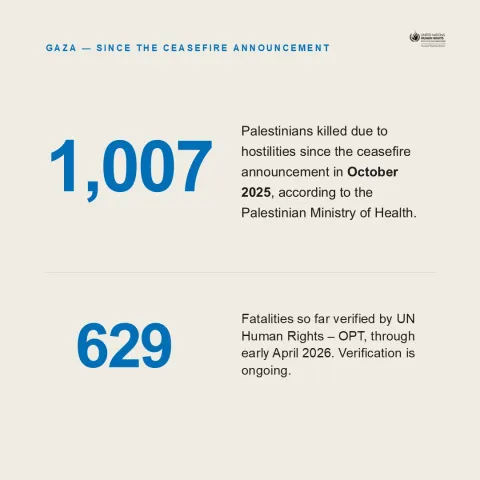
More than 1,000 Palestinians killed in Gaza since the announcement of a ceasefire in October 2025. Here is what we know:

Image
1,007 killed according to MOH, 629 verified killed so far

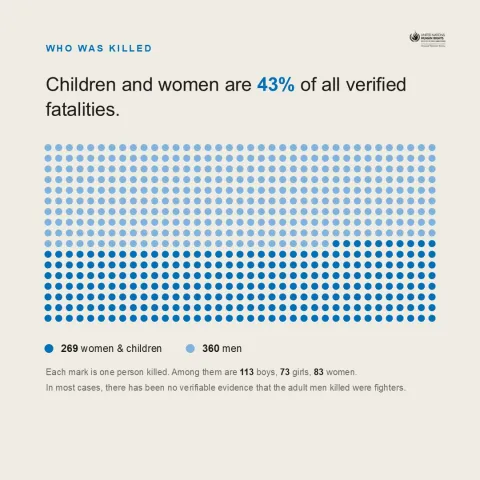
269 women and children among the 629 fatalities verified by UN Human Rights - Palestine in Gaza since the announcement of a ceasefire in October 2025 through early April, verification is ongoing.

Image
269 women and children among 629 verified fatalities

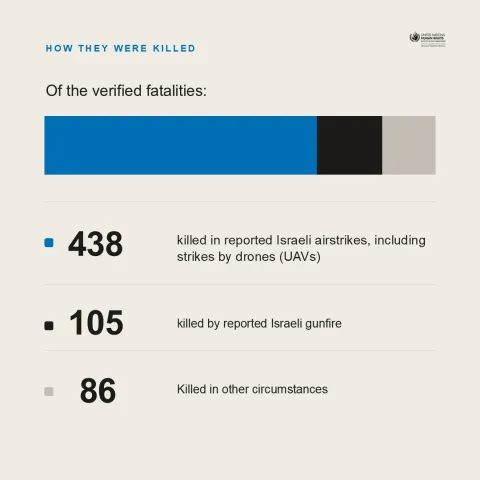
438 of the 629 verified fatalities since the announcement of a ceasefire in Gaza were killed in reported Israeli airstrikes, including strikes by unmanned aerial vehicles (UAVs).
 

Image
Breakdown of fatalities by reported means of killing

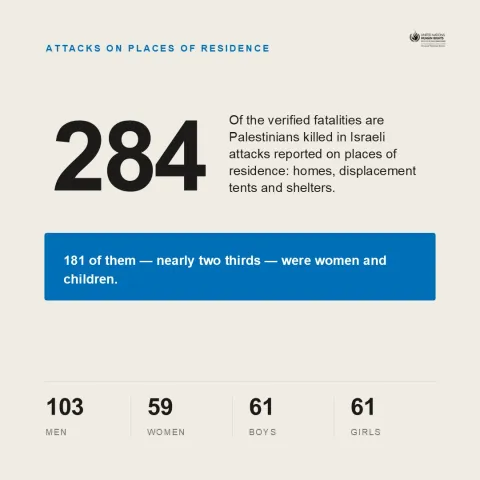
284 of the 629 fatalities verified by UN Human Rights - Palestine in Gaza since the ceasefire announcement were killed in their homes, tents, or shelters.

Image
284 killed in homes or shelters

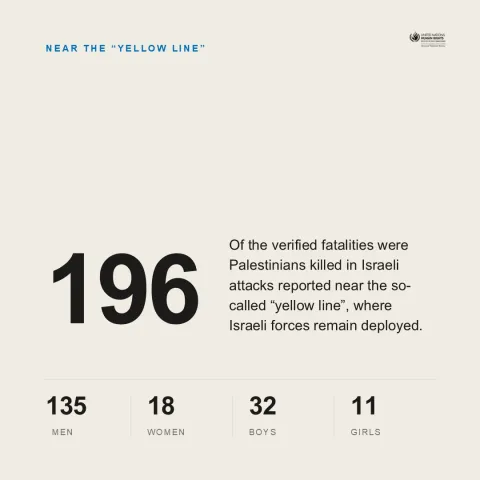
196 Palestinians were killed in Israeli attacks reported near the so-called "yellow line" out of the 629 fatalities verified by UN Human Rights - Palestine since the ceasefire announcement through early April.

Image
196 killings in the vicinity of the so-called yellow line

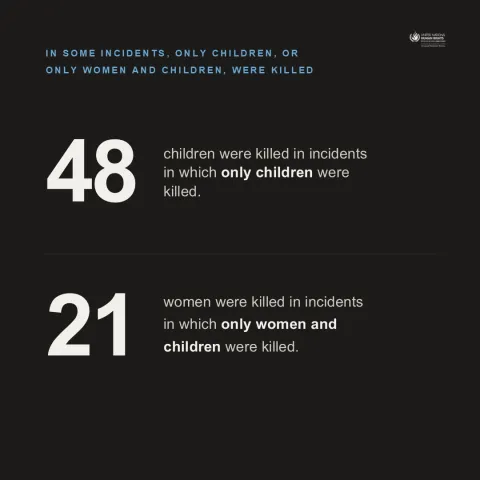
Since the ceasefire announcement in Gaza in October 2025, some incidents only killed children, or only killed women and children. 

Image
48 children killed in attacks whose victims were all children
12 June, 2026

Surviving childhood under occupation - The catastrophic harm facing Palestinian children

Surviving childhood under occupation - The catastrophic harm facing Palestinian childrenIsraeli violence is subjecting Palestinian children to catastrophic levels of harm: killed, maimed, displaced, a...

Surviving childhood under occupation - The catastrophic harm facing Palestinian children

Israeli violence is subjecting Palestinian children to catastrophic levels of harm: killed, maimed, displaced, and living in perpetual insecurity.

On Saturday, 6 June 2026, Israeli security forces shot and killed 7-month-old Sam Fahed Abu Haykal in his parents’ car near a Hebron checkpoint. The bullet appears to have passed through Sam’s head and injured both his parents. Video footage analysed by an Israeli human rights organisation shows a member of the Israeli security forces shooting at the car as it was slowing down, posing no threat, and clearly indicates that he provided no aid to the family afterwards.

Sam is one of 241 children killed by Israeli security forces and settlers in the occupied West Bank since 7 October 2023, as verified by the UN Human Rights in the Occupied Palestinian Territory (OHCHR OPT). This is in addition to over 21,000 children who have been killed in Israeli attacks in Gaza in the same period, according to the Palestinian Ministry of Health, with killings continuing after the announcement of a ceasefire in October 2025.

Since the ceasefire announcement, the Palestinian Ministry of Health has reported the killing of 981 Palestinians in Israeli attacks in Gaza. OHCHR OPT has so far verified the killing of 574 Palestinians during this period, including 183 children, five of whom were infants under the age of one.

On 4 February 2026, Israeli forces opened fire on an encampment for displaced people in Al Tuffah, Gaza City, killing five Palestinians, including two women and two baby girls: 5-month-old Mira Al Khabbaz and Watein Al Khabbaz, born less than a week before.

Forty-eight of the 183 verified child fatalities after the ceasefire announcement were victims of incidents in which only children were killed, raising concerns about Israeli forces directly targeting Palestinian children. Fifteen women have also been killed in incidents in which only women, or only women and children, were killed.

On 29 October 2025, an Israeli airstrike hit a tent housing displaced people in Al Mawasi, Khan Younis, and killed three Palestinians: two brothers aged eight and 11, and their 15-year-old sister. On 31 January 2026, an Israeli strike hit a residential building in western Gaza City, killing two women aged 60 and 23, and three sisters aged five, seven and nine. On 2 February 2026, Israeli Naval Forces killed one Palestinian, a 2-year-old boy, in his tent on the coast of Al Mawasi, Khan Younis.

In the West Bank, the 241 verified child fatalities represent nearly one in five of the 1,103 Palestinian victims killed by Israeli security forces and settlers since 7 October 2023.

In March 2026, three months before the shooting that killed 7-month-old Sam in Hebron, a similar attack in Tammun, south of Tubas, killed four family members in their car. At the time, Israeli security forces opened fire on a Palestinian vehicle, killing a father, Ali Bani Odeh, a mother, Wa’ad Bani Odeh, and their 5- and 6-year-old sons, Mohammad and Othman. Two children survived the shooting, aged eight and 11, but later reported that they were assaulted by Israeli security forces when they left the car.

Most of the children killed in the West Bank are teenage boys, 213 out of 241. In many cases, subsequent statements by Israeli authorities accuse the children of having engaged in stone-throwing as a justification. In all OHCHR OPT-verified killings of minors involved in confrontations with Israeli security forces, our assessment is that none posed an imminent threat to life —the only legal justification for the use of lethal force in the occupied West Bank under international law. Where less harmful means were available, such lethal force may constitute an arbitrary deprivation of life and, in the context of occupation, may amount to willful killing, a war crime.

On 20 December 2025, a member of Israeli security forces hiding behind a wall shot and killed 16-year-old Rayan Abu Mulla in Qabatiya, south of Jenin, on his way home. An official Israeli statement claimed Rayan was throwing stones. However, according to witnesses and CCTV footage, he was walking empty-handed. Israeli security forces also prevented ambulances from assisting Rayan. They then took his body away and refused to hand it over for burial.

OHCHR OPT’s analysis demonstrates a pattern of Israeli security forces preventing medical assistance to injured Palestinians and withholding bodies, including those of children.

Children are civilians and have special protections under international humanitarian law and international human rights law. The routine assault on their right to life, safety, and liberty in the Occupied Palestinian Territory at this massive scale points to war crimes.

“From newborns to teenagers, Palestinian children have not been spared extraordinary levels of Israeli violence. The pattern, at a minimum, shows a dangerous scale of dehumanisation and disregard for Palestinian lives,” said Ajith Sunghay, Head of UN Human Rights in the Occupied Palestinian Territory. “Palestinian children must be able to grow up in safety, with the same rights and protections as children anywhere else in the world. Surviving childhood should never be this difficult.”

10 June, 2026

Concerns about conduct of Palestinian armed elements in Gaza

We are increasingly concerned about repeated reports of violent activity by Palestinian armed elements in Gaza that appear to be backed by Israeli forces.Tuesday morning, 9 June, members of these arme...

We are increasingly concerned about repeated reports of violent activity by Palestinian armed elements in Gaza that appear to be backed by Israeli forces.
Tuesday morning, 9 June, members of these armed elements established a checkpoint near Wadi Gaza on Salah Al Dein Street in central Gaza and detained several Palestinians, including seven ambulance crew members from the Palestinian Red Crescent Society (PRCS). Five were released later. The remaining two were taken to an unknown location. As of today, their fate and whereabouts remain unknown according to PRCS.  
This is unacceptable, and these healthcare workers must immediately be released.
As an occupying power, Israel has obligations to ensure public order and safety in Gaza, and to refrain from, as well as prevent, such violations of international law, including the obstruction of medical services.
 

3 June, 2026

UN Human Rights condemns repeated Israeli attacks on police personnel in Gaza

UN Human Rights condemns repeated Israeli attacks on police personnel in GazaThe UN Human Rights Office in the Occupied Palestinian Territory condemns Israeli forces’ routine targeting of police perso...

UN Human Rights condemns repeated Israeli attacks on police personnel in Gaza

The UN Human Rights Office in the Occupied Palestinian Territory condemns Israeli forces’ routine targeting of police personnel in Gaza in repeated attacks. Since January 2026, UN Human Rights has recorded at least twelve attacks against police, killing at least 53 civilians, including 35 police personnel, 5 boys, and 1 woman. Four attacks were recorded in May alone, killing 12 policemen.

Israeli attacks against police personnel have been reported during ordinary law enforcement operations, including directing traffic and patrolling streets and markets. The pattern demonstrated disregard for civilian lives, including that of police personnel, with several strikes taking place in crowded areas, killing, in addition to police personnel, internally displaced persons, children, and prison inmates.

On 23 May, an Israeli strike struck a police checkpoint in the Al Tawam area, Gaza City, killing at least five police officers and two others, including a boy. On 24 April 2026, an Israeli drone struck a police vehicle carrying out a law enforcement operation in the Beer 19 area of Al Mawasi camp, west of Khan Younis — a crowded encampment of displaced Palestinians. The attack killed four policemen, as well as three other men and a nine-year-old boy from nearby tents. It occurred at the time of sunset prayers, when many Palestinians were moving from their tents to a nearby mosque.

On 31 January 2026, an Israeli airstrike hit Ash Sheikh Radwan Police Station, northwest of Gaza City, killing at least 11 Palestinians, including five police officers, one of them a woman. Six more people, including a boy, were also killed in the airstrike, including inmates and people visiting the station for services.

The pattern of attacks raises concerns that Israeli forces apply no distinction between police personnel and fighters belonging to armed groups in Gaza. However, under international humanitarian law, police personnel are civilians who are protected against attack, unless and for such time as they directly participate in hostilities. Attacks targeting police personnel simply for performing ordinary law enforcement and policing functions would amount to war crimes.

The attacks also fit a broader pattern of Israel’s systematic failure to take constant care to spare civilians and civilian objects in its conduct of hostilities in Gaza. Even in the event that one or several of these attacks targeted fighters, the location and timing of the attacks in crowded areas and the use of weapons with wide-area effects indicate that Israeli forces have failed to take feasible precautions to avoid and minimize incidental loss of civilian life.

“As an occupying power, Israel has obligations under international humanitarian law to ensure, as far as possible, that Palestinians have public order and safety. Instead, the systematic targeting and dismantling of public governance institutions has created chaos with devastating impact on civilians,” said Ajith Sunghay, Head of UN Human Rights in the Occupied Palestinian Territory. “Nearly eight months have passed since the announcement of a ceasefire, and there is no end in sight for the killings, the turmoil, and the misery.”

29 May, 2026

Attacks on Gaza over Eid kill 26, as Israeli forces push deeper into the strip

Attacks on Gaza over Eid kill 26, as Israeli forces push deeper into the stripUN Human Rights in the Occupied Palestinian Territory (OHCHR OPT) condemns the increase in Israeli attacks in Gaza since t...

Attacks on Gaza over Eid kill 26, as Israeli forces push deeper into the strip

UN Human Rights in the Occupied Palestinian Territory (OHCHR OPT) condemns the increase in Israeli attacks in Gaza since the eve of Eid Al Adha on Tuesday, 26 May. At least 26 Palestinians were killed since Tuesday including six women and seven children as Palestinian families prepared to observe Eid amid displacement, deprivation, and insecurity.

Three airstrikes on 26 May killed 12 Palestinians. In the early morning hours, one more 14-year-old girl died of injuries sustained in an Israeli airstrike the day before that also killed a 30-year-old woman and a five-year-old girl according to initial information. Since the announcement of a ceasefire, at least 32 children and eight women have been killed in Israeli attacks in which fatalities were exclusively women and children.

One of the airstrikes on 26 May killed four men in eastern Al Maghazi camp, Middle Gaza, reportedly after they resisted attempts to search their homes by armed gangs allegedly supported by the Israeli military. Another airstrike hit a car in Al Mawasi, Khan Younis, killing two men. The third airstrike struck an apartment in Al Rimal, Gaza City, and killed a newly appointed commander of Hamas’s Al Qassam Brigades together with his wife, his two sons, aged 15 and 22, his daughter, aged 9, and a woman passerby.

On the first day of Eid Al Adha, 27 May, an Israeli airstrike in central Gaza City reportedly killed at least ten: four girls, one boy, three women, and two men allegedly affiliated with Al Qassam Brigades.

Since the announcement of a ceasefire, Israeli forces have killed 922 Palestinians in attacks across Gaza, bringing the total death toll since 7 October 2023 to nearly 73,000.

OHCHR OPT has consistently warned that Israel’s attacks in Gaza violate international humanitarian law’s principles of distinction, proportionality, and precaution in attacks. A recent OHCHR OPT report also concluded that the totality of Israeli conduct in Gaza raises serious concerns about Israel’s compliance with its obligations to prevent acts prohibited under the Genocide Convention.

The Israeli blockade on Gaza is also still depriving Palestinians of necessities, including adequate shelter, essential medicines, and food items. Almost everyone is displaced and concentrated into less than half the land area of Gaza— hemmed in by Israeli ground forces that continue to move west, displacing families and pushing them into a progressively narrower strip of land. In recent days, multiple displacement orders were issued, forcing people out of their shelters. The Israeli Prime Minister announced yesterday that he had directed Israeli forces to expand their deployment to cover 70 per cent of Gaza. The continued contraction of areas available to civilians raises grave concerns about access to humanitarian assistance, and the ability of displaced families to find any meaningful safety.

“Our concerns about the commission of war crimes in Gaza have not stopped,” said Ajith Sunghay, Head of UN Human Rights in the Occupied Palestinian Territory. “It is difficult enough to navigate life in chronic displacement in the ruins of Gaza, under blockade, and after Israeli attacks virtually destroyed every essential system: healthcare, education, food production, law enforcement and civil order. Continuing military attacks on a population living under these conditions is unthinkable.”

19 May, 2026

Occupied Palestinian territory: UN report on large-scale violations, including atrocity crimes

Occupied Palestinian territory: UN report on large-scale violations, including atrocity crimesRemarks by Ajith Sunghay, head of the UN Human Rights Office in the occupied Palestinian territoryGood aft...

Occupied Palestinian territory: UN report on large-scale violations, including atrocity crimes

Remarks by Ajith Sunghay, head of the UN Human Rights Office in the occupied Palestinian territory

Good afternoon and thank you for being here today.

Today I’m presenting this report which covers 19 months of large-scale violations of international law including atrocity crimes, from October 2023 to the end of May 2025.

One year later, despite the ceasefire concluded in October 2025, the lasting consequences of the patterns we documented are apparent.

The ceasefire diminished the immense scale of violence up to that point, and opened some modest humanitarian space. But killings and the destruction of infrastructure have continued on an almost daily basis, and the overall humanitarian situation remains dire. All while Hamas continues its own violations, including against the people of Gaza. 

In the West Bank, the rate of forcible displacement of Palestinians is unseen in decades and Israeli settlement expansion is unprecedented. Israeli military and police forces and settlers are killing more and more Palestinians with impunity, often together.

The chronicle of violence and injustice continues, and will impact Palestinians for generations to come.

The report points to war crimes and possible crimes against humanity by Israeli and Palestinian duty bearers.

On and after 7 October 2023, Palestinian armed groups committed war crimes and possible crimes against humanity when they horrifically attacked civilians in Israel, killed at least 1,124, took and kept hostages, and fired thousands of unguided missiles into Israel for over a year. Released hostages have provided credible accounts of torture and ill-treatment, including sexual violence. Thankfully, no more hostages remain in Gaza today.

On and after 7 October 2023, Israel unleashed devastating violence and dispossession in Gaza and the West Bank, committing war crimes and possible crimes against humanity. The report finds that the totality of Israeli conduct in Gaza raises serious concern about Israel’s compliance with its obligation to prevent acts within the scope of the Genocide Convention.

The fact remains that Palestinians have no means to ensure their survival or to protect their loved ones, with hundreds killed since the announcement of a ceasefire.

The Israeli military has killed 72,769 Palestinians since 7 October 2023 in Gaza: in their homes, in IDP shelters, in hospitals, in schools, in places of worship, on the streets, while queuing for aid, while trying to fish in the sea.

During the reporting period, the Israeli blockade on Gaza resulted in starvation and famine that was foretold and later confirmed. Hundreds starved to death, including children. Any use of starvation as a method of war against civilians is a war crime, and it may amount to a crime against humanity and even genocide in certain conditions.

Displaced Palestinians have scant prospects of return, raising concerns about ethnic cleansing and forcible transfer. In Gaza, the neighbourhoods they fled are gone as Israeli forces continue to unlawfully demolish buildings across Gaza— homes still laden with thousands of unretrieved Palestinian bodies.

In the West Bank, Israeli forces and settlers have killed 1,096 Palestinians since 7 October 2023, one in five of them children. Many incidents raise concerns about unlawful killings and extrajudicial executions.

Settler attacks are routinely carried out with the support, acquiescence, or participation of Israeli security forces. The Israeli government has intensified the militarisation of the settler movement, shielded them from accountability, and now actively benefits from settler violence as a catalyst for its stated annexation agenda.

The dispossession in the West Bank is also systematic and relentless, matched in intensity with the record rate of settlement expansion. Since this government took office, settlements increased by 80%, adding 102 settlements to the 127 that existed previously. 

The 33,000 Palestinians displaced from Jenin, Tulkarem, and Nur Shams refugee camps in 2025 remain unable to return to their homes.

Israeli authorities are forcing Palestinians out of their homes around the Old City in East Jerusalem at alarming levels, turning their properties over to settlers, or making room for settlement projects including a park and a cable car project.

Settler violence has become a key driver of displacement, so far displacing 45 entire Palestinian communities since October 2023.

The report documents more patterns that have alarmingly persisted.

Torture and ill-treatment of Palestinian detainees in Israeli custody is all too routine, including sexual violence, even cases of rape. as well as denial of sufficient sustenance and medical care.

And discriminatory practices have further reinforced Israel’s violation of the prohibition of apartheid and racial segregation.

And why does it all seem so endless?

Because not enough is being done to stop it. The ceasefire has not led to any forms of meaningful accountability for the violations committed in the preceding years. Nor has it led to any fundamental reckoning with the underlying driver – the protracted occupation.

Impunity only fuels recurrence. Most of the horrors documented here, and those documented for decades before, have gone unpunished, with no prospect of justice for the victims.

Beyond statements of condemnation, third States must urgently take every measure at their disposal and in conformity with international law to end the Israeli occupation, ensure the dismantlement of existing settlements, protect civilians, achieve accountability for serious violations by all parties, and ensure Palestinians are able to exercise their human rights.

In a context like this, lack of action is not passivity. It is a license.