13 August, 2026

Settler encroachments and attacks on Palestinian homes are beyond a boiling point

Settler encroachments and attacks on Palestinian homes are beyond a boiling pointIsraeli authorities must immediately remove settlers who are violently displacing thousands of Palestinians, unlawfully...

Settler encroachments and attacks on Palestinian homes are beyond a boiling point

Israeli authorities must immediately remove settlers who are violently displacing thousands of Palestinians, unlawfully grabbing Palestinian land and expanding settlements.

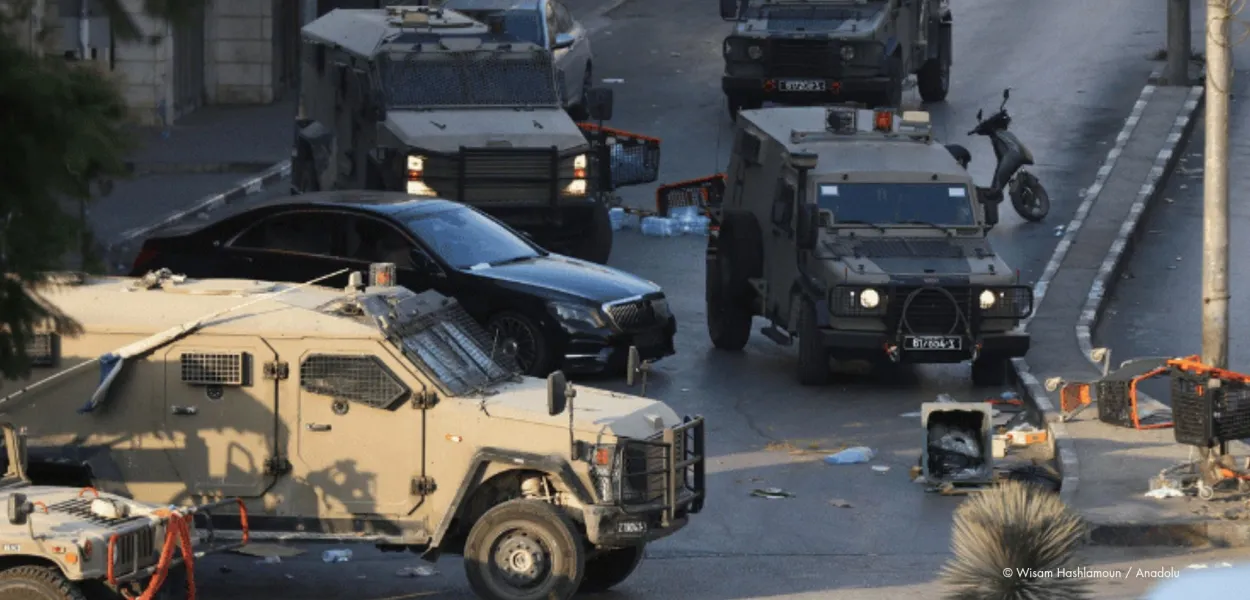
Since the establishment of an Israeli settler outpost near Qusra, a Palestinian town located in Nablus Governorate in Area B of the occupied West Bank in November 2025, Israeli settlers have reportedly taken control of the area west of the town, located in Area B. During this time, Palestinians living in Qusra have endured increasingly frequent attacks by settlers, including home invasions, physical assaults, acts of vandalism, theft and arson, including against a local mosque.

In an emblematic case of settler violence, in July, Israeli settlers from an outpost located in the Ras al Ein area of Qusra cut the water and electricity supply to three Palestinian homes located nearby. Then, on 9 August, the settlers closed all the gates and entrances leading to these Palestinian homes and set up a tent between the houses, refusing to allow anyone to enter or leave the area. This has resulted in three Palestinian households, comprising some 15 people including at least two children, being trapped inside their homes in a state of terror, unable to attend to their basic needs and without access to water or electricity.

The families reported that they requested Israeli security forces present at the site to intervene, but to no avail. Instead, Israeli security forces seem to have blocked medics, solidarity activists and journalists from reaching the families. In a sign that could indicate collusion between the ISF and settlers, video footage shows soldiers praying together with settlers at the location. On 12 August, soldiers eventually dismantled the settlers’ tent without removing the settlers who, as of 13 August, are still surrounding the homes.

These criminal actions by the settlers, supported or acquiesced to by Israel, the Occupying Power, are making life unbearable for these Palestinian families, and are clearly aimed at forcing them to leave their homes and land. Time is running out for these three families before they are forcibly displaced.

The International Court of Justice is clear that all Israeli settlements are illegal and that Israel is obligated to cease all settlement activities, evacuate all settlers, including those terrorizing Qusra and Jalud, and bring to an end its unlawful presence in the West Bank. In the meantime, Israel must comply with its obligations under the laws of occupation to ensure the security of the local Palestinian population, which includes preventing attacks by Israeli settlers unlawfully present in the occupied West Bank, investigating such attacks and ensuring accountability of those found responsible for conducting, supporting or tolerating these attacks, including through the imposition of sentences commensurate to the abuses and violations.

6 July, 2026

Four-month-old dies at Israeli gate west of Ramallah

Four-month-old Ahmed Marouf Zaid died yesterday after Israeli soldiers refused to open a gate blocking the main entrance to his village west of Ramallah, delaying his access to urgent medical care. An...

Four-month-old Ahmed Marouf Zaid died yesterday after Israeli soldiers refused to open a gate blocking the main entrance to his village west of Ramallah, delaying his access to urgent medical care. An ambulance was waiting on the other side.

"Last month, 7-month-old Sam Abu Haykal was shot and killed by an Israeli soldier at a checkpoint. Yesterday, a critically ill 4-month-old was forced to wait for urgent medical care just steps from an ambulance. Both deaths are senseless, and both are emblematic of an occupying power continuing to show utter disregard for the humanity and rights of Palestinians living under occupation," said Ajith Sunghay, Head of UN Human Rights in the Occupied Palestinian Territory.

According to OCHA, road gates like the one closed to Ahmed’s family make up 41% of the 925 Israeli movement obstacles that permanently or intermittently restrict the movement of 3.4 million Palestinians across the occupied West Bank.

13 May, 2025

Israeli security cabinet’s decision to resume land registration in Area C of the occupied West Bank is deeply troubling

The UN human rights office in the Occupied Palestinian Territory is alarmed by reports that the Israeli security cabinet on 11 May decided to resume land registration in Area C of the occupied West Ba...

The UN human rights office in the Occupied Palestinian Territory is alarmed by reports that the Israeli security cabinet on 11 May decided to resume land registration in Area C of the occupied West Bank. The registration, which was suspended in 1968, appears to be the latest tool used by Israel to acquire Palestinian land and consolidate the unlawful annexation of the West Bank.

The process of land registration or settlement of land title, under which Israel purportedly seeks to definitively establish land ownership registration in favour of Israeli settlers, represents an exercise of sovereignty prohibited in occupied territory. The office has in the past raised concerns that the settlement of title in East Jerusalem, ongoing since 2018, has been conducted in a discriminatory manner and has resulted in the seizure of Palestinian lands and property for the establishment of Israeli settlements, while placing Palestinians at risk of evictions. Similar concerns arise with any process of settlement of title in Area C of the occupied West Bank.

The announcement by the Israeli government cannot be separated from recent legislative initiatives to further extend Israeli sovereignty, including through allowing Israeli individuals to purchase land in the West Bank, which Israel, as the Occupying Power should hold in trust for the Palestinian population, the dramatic intensification of violent and discriminatory practices against Palestinians such as demolitions and movement restrictions, and the continued expansion of settlements and settlement infrastructure. These policies have been accelerated in the shadow of the escalation of hostilities in Gaza and have, along with relentless settler attacks, led to the forcible transfer of thousands of Palestinians, particularly from Area C, and are changing the geography and demography of the West Bank.

If pursued, land registration by the occupying power would likely result in further expropriation of Palestinian land and natural resources in violation of the property rights of Palestinians, as well as other rights such as the rights to housing and shelter, food, and the benefit of Israeli settlers and settlements.

In this context, such a land registration exercise would also be in violation of Israel’s obligations as an occupying power, as it would not only be exceeding its limited legislative powers but would further entrench 50 years of unlawful transfer by the occupying power of its population into the occupied territory. 

7 March, 2025

Palestinian suffering continues as disregard for international law grows

Across the Occupied Palestinian Territory, the Palestinian people continue to increasingly grapple with Israel’s complete disregard of its obligations under international law to protect Palestinians a...

Across the Occupied Palestinian Territory, the Palestinian people continue to increasingly grapple with Israel’s complete disregard of its obligations under international law to protect Palestinians and their chances of building a future that fulfills their rights to a dignified life and to self-determination.

Precarious situation in Gaza:

In Gaza, since the ceasefire agreement entered into effect on 19 January, Israeli military reportedly killed 58 Palestinians including ten children and three women, mostly in the vicinity of the Israeli imposed “nogo” zones including the Netzarim and Philadelphi corridors, as well as eastern Rafah, Khan Younis, and Beit Hanun. Many of those killed were reportedly attempting to check on their homes. Targeting Palestinians who are not actively participating in hostilities is a war crime regardless of the Israeli-imposed movement restrictions.

For the fifth consecutive day, Israel has blocked humanitarian aid as well as all other goods and supplies, including fuel, from entering Gaza, causing prices to soar and anxiety to spread over the possible return to bombardment and starvation. This is coinciding with the start of the Holy month of Ramadan, further heightening the stress of Palestinian families, most of whom remain displaced. Lack of adequate shelter, warm clothing and healthcare services led to the death of at least eight babies in the past two weeks from the cold, three of whom were reportedly newborns.

As the occupying power, Israel has a legal obligation to ensure the provision of the necessities of life for Palestinians living under its control. This includes food, clean water, shelter, and adequate healthcare. Any denial of the entry of the necessities of life for civilians may amount to collective punishment. The use of hunger and starvation as a weapon of war is a war crime.

Additionally, efforts to remove tons of rubble and waste are greatly hampered by the lack of the required heavy equipment and fuel. Palestinian families and civil defence workers continue to extract bodies from under the rubble — at least 808 bodies recovered since the ceasefire started.

Large-scale West Bank operation continues:

In the West Bank, an Israeli security operation continues to ravage northern communities, killed dozens, forcibly displaced about 40,000 Palestinians, emptying entire refugee camps. The Israeli Minister of Defense told media that Israeli security forces will remain in parts of the emptied territory for a year and will prevent residents from returning. The operation started on 21 January and preliminarily targeted Jenin, then extended to include Tubas and Tulkarem governorates. So far, Israeli security forces have killed 54 Palestinians in the course of this operation, including eight children, and two women. Outside these governorates, during the past two weeks, Israeli security forces killed five other Palestinians including a 12-year-old boy shot in the back in Hebron.

The killings increasingly demonstrate an alarming disregard for Palestinian lives with high prevalence of unlawful killings. As there are no hostilities in the West Bank, the international human rights law standards on the use of force in law enforcement operations apply. Instead, Israel now routinely resorts to using tactics and weapons developed for war fighting, including the deployment of airstrikes and tanks.

Alarming incidents reported over recent weeks include Israeli security forces opening fire at a house in Jenin, killing a two-day old baby girl inside; shooting and killing an eight-month pregnant woman trying to flee Nur Shams refugee camp in which an operation by the Israeli security forces was ongoing; the killing of a 13-year-old girl in the courtyard of her house also in Jenin; and the killing of a ten-year old boy while standing in front of a building in Tulkarem.

Since January, three members of Israeli security forces were killed by Palestinian armed men in the West Bank or inside Israel. A 17-year-old Israeli girl succumbed to injuries sustained when a Palestinian man rammed a car into a crowd of Israelis in north Israel last week. The attacker was subsequently shot and killed.

Coinciding with the operation, restrictions of movement have also dramatically increased, strangling communities and preventing thousands of students and workers in northern areas from reaching their schools and workplaces.

According to Israeli media, Israeli security forces are planning to limit the number of worshippers from the West Bank allowed to access Al Aqsa Compound in East Jerusalem for Friday prayers during Ramadan to only 10,000. This is a significant drop from the tens of thousands who gathered for Friday prayers in Al Aqsa Mosque in previous years. Ahead of the first Ramadan Friday prayer tomorrow, Israeli media is reporting movement restrictions around East Jerusalem, including the deployment of thousands of security officers and the closing of key roads, which is likely to have a severe impact on freedom of movement.

Steps to consolidate annexation and forced transfer:

Of particular concern is the mass forced displacement in large swaths of the Occupied Palestinian Territory. In Gaza, Israeli forces’ continued presence, and the constant killing of Palestinians around the Israelidesignated no-go zones is effectively preventing Palestinian residents from returning to their homes in these areas.

In the newly emptied parts of the West Bank, houses are being reportedly destroyed. At least 120 buildings in Jenin and 41 in Tulkarem have been demolished so far, apparently to make space for the creation of wide streets that would allow easier passage to military forces. Israeli security forces also announced that they will imminently demolish 16 houses in Nur Shams refugee camp. Signs are being erected that give freshly bulldozed streets and junctions Hebrew names in Jenin and Tulkarem.

In parallel, increasing numbers of Palestinian herding and farming communities are being displaced from Area C and other fertile areas of the West Bank, forced to leave by state and settler violence, restricted access to land and pastures, and discriminatory policies.

These steps are being taken against a backdrop of a barrage of statements from Israeli officials and lawmakers promoting further consolidation, under Israeli law, of the annexation of large parts of the Occupied Palestinian Territory. Statements also call for the forcible transfer and deportation of Palestinians in Gaza.

Earlier this week, the Ministerial Committee at the Israeli Knesset preliminarily approved a bill to extend Israeli law, jurisdiction and administration to settlements around Jerusalem, which would further cement annexation. This threatens to further fragment the Occupied West Bank, further isolate the Palestinian residents of East Jerusalem, and complicate any future efforts to fulfil Palestinians’ right to self-determination. Israeli media quoted lawmakers who explained the bill is a significant step towards extending Israeli sovereignty over the West Bank.

Measures to forcibly displace Palestinians and consolidate the annexation of their land fly in the face of Israel’s obligations under international law, including its duty to end its unlawful presence in the Occupied Palestinian Territory and to immediately evacuate all settlements as affirmed by the International Court of Justice. These measures must stop and be reversed, and Palestinians across the occupied territory must be allowed to return to their homes in safety and in dignity.

Accountability must be prioritised for violations committed by all duty bearers, including Israel, Palestinian armed groups, and the Palestinian Authority as an essential step towards a just and sustainable peace.
28 January, 2025

Accountability and human rights – basis of just peace in the Occupied Palestinian Territory

As hundreds of thousands of Palestinians move back to northern Gaza, violence and displacement continue to afflict both Gaza and the West Bank, raising more concerns about violations of international ...

As hundreds of thousands of Palestinians move back to northern Gaza, violence and displacement continue to afflict both Gaza and the West Bank, raising more concerns about violations of international law and renewing calls for an immediate end to all violence and accountability.

On the move in Gaza

With the return of possibly hundreds of thousands of Palestinians to northern Gaza, the UN Human Rights Office reaffirms the rights of Palestinians to safety, protection, and dignity on their way back to what is left of their homes.

The journey is difficult, with many unable to afford transportation and forced to walk long distances with unreliable telecommunication networks and no available toilets. This is particularly hard for the most vulnerable groups and the families who support them, including children, pregnant women, older people, and people with disabilities forced to make the journey without adequate assistance. Reports raise concern about an increasing number of children being separated from their families while on the move.

As the occupying power, Israel has the obligation to ensure the provision of shelter, food and medical care and to restore and maintain public order and normal civil life for the Palestinian people. Israel is also prohibited from subjecting Palestinians to deportation outside the Occupied Palestinian Territory or forcible transfer within it.

Killings continue around “buffer zones”

The continued killings of Palestinians since the beginning of the ceasefire in and around vaguely defined and poorly communicated “buffer zones” in Gaza, particularly in the vicinity of the Netzarim and Philadelphi corridors and along the eastern barrier fence, is cause for alarm.

As of 27 January, the Israeli military reportedly killed at least 14 Palestinians, including 2 boys and 1 girl, mostly around these so-called “buffer zones” since the onset of the ceasefire on 19 January. Among those killed are two Palestinian brothers, including a boy, who were killed while reportedly checking their home in Rafah outside of such a zone.

The Israeli military remains bound by international humanitarian law’s principles of distinction, proportionality and precautions, as well as the relevant human rights rules on use of force applicable to law enforcement. As a matter of urgency, it must take immediate steps to ensure its rules of engagement prevent further unlawful civilian deaths.

Growing violence in the West Bank

Accountability and adherence to international law are also urgently needed in the West Bank, where a large-scale operation is unfolding with devastating consequences for Palestinians, both in terms of violence and displacement. Since 19 January, Israeli security forces killed 20 Palestinians including a 16-year-old boy in East Jerusalem on Monday.

Deadly operation in Jenin

An Israeli operation has continued in Jenin since 21 January with deadly consequences and was extended this week to Tulkarem. Israeli security forces have so far killed at least 18 Palestinians in this operation, most of whom are reportedly unarmed.

This includes a two-year-old girl who was shot dead in her home by Israeli security forces on Saturday.

After weeks of siege and use of force by both the Israeli and Palestinian security forces, 3,000 families from the Jenin Refugee Camp have been forced to flee – about 80 percent of total Camp residents. The remaining families are living in grave danger with no access to water, electricity, and other basic services.

Videos circulating on the internet and reported by the media show evidence of Israeli security forces targeting Palestinians clearly posing no threat to life or limb. The use of tactics and weapons developed for war such as airstrikes in the West Bank where there are no active hostilities violates the international human rights law standards applicable to law enforcement.

On Monday afternoon, the Israeli military expanded its operations to Tulkarem and its two refugee camps, where further destruction of roads and infrastructure is reportedly ongoing. According to information gathered by the UN Human Rights Office, several Palestinian families were already forced to leave their homes by the Israeli military for the duration of the operation, despite the fact they have nowhere to go in the middle of the winter.

Raids and movement restrictions continue

In addition, Israeli security forces in recent days have continued their routine raids of Palestinian communities across the West Bank including in Hebron, Nablus, and Bethlehem. Houses of Palestinian prisoners released as part of the ceasefire deal were also raided to prevent any “display of joy.”

Suffocating restrictions on Palestinians’ freedom of movement across the West Bank persisted for the tenth consecutive day today, practically tearing communities apart and largely paralysing daily life.

Human rights central to the way forward

The continued implementation of the ceasefire deal in Gaza provides hope that an end to the horrors of the past 15 months is in sight. Israel and Palestinian armed groups must do everything in their power to make sure the ceasefire is sustainable so that the massive protection and humanitarian needs of the civilian population in Gaza can be addressed, and the process of a human rights-based recovery and reconstruction can commence.

A vital prerequisite for this goal is to ensure strict adherence to international law in this critical time. The international community must also prioritize accountability for the crimes under international law committed over the past 15 months to facilitate redress and justice for victims. To prevent recurrence, it is essential that the root causes of the conflict are addressed based on international law, in particular human rights. This includes ending Israel’s unlawful presence in the Occupied Palestinian Territory and ensuring accountability as the basis of just and lasting peace that fulfills the rights of Palestinians and Israelis. 

20 January, 2025

Violence and restrictions in the Occupied West Bank coinciding with ceasefire implementation

Violence and restrictions in the Occupied West Bank coinciding with ceasefire implementation The UN Human Rights Office is alarmed by a wave of renewed violence perpetrated by settlers and Israeli sec...

Violence and restrictions in the Occupied West Bank coinciding with ceasefire implementation The UN Human Rights Office is alarmed by a wave of renewed violence perpetrated by settlers and Israeli security forces in the Occupied West Bank, coinciding with the implementation of the Gaza ceasefire agreement and the release of hostages and detainees. This has been accompanied by increased restrictions on Palestinians’ freedom of movement across the West Bank, including complete closure of some checkpoints and installation of new gates, effectively confining entire communities. 

Public statements by Israeli officials warning against celebrations by Palestinian families whose detained loved ones are being released coincided with calls by settlers for gatherings and attacks at locations where detainees are returning. Settler attacks followed, on 19 January, in several towns including Sinjil, Turmus’ayya, and Qalqilya, where scores of settlers torched Palestinians’ houses and vehicles, blocked roads, and threw stones. Six Palestinians were injured in Sinjil, including three children, aged between 14 and 16. 

Also yesterday, Israeli security forces raided several Palestinian towns in the West Bank. In Sebastia, Nablus, Israeli security forces shot in the chest and killed a 14-year-old Palestinian boy, reportedly unarmed, in the absence of confrontations or clashes. Public statements by Israeli military officials also raise concern about Israel’s plans to expand and increase operations in the Occupied West Bank. 

Israeli security forces also closed a number of checkpoints in Jericho, set up flying checkpoints in Tulkarm, and further increased searches and controls at checkpoints around Nablus and Tulkarm governorates. They additionally shutdown all entrances to Hebron, which has effectively cut off thousands of Palestinians from neighboring communities and largely prevented children from attending schools, and residents from reaching work. Thirteen new iron gates were reportedly installed at entrances of towns across the Occupied West Bank. 

Palestinian security forces detained several Palestinians, including journalists, covering the release of Palestinian detainees. 

While the ceasefire takes hold in Gaza, it is important to stress again that international law binds duty-bearers in the Occupied Palestinian Territory. Israel has the obligation to dismantle settlements and evacuate all settlers from the Occupied West Bank and end its unlawful presence across the Occupied Palestinian Territory as rapidly as possible. In the meantime, Israel has an obligation as the occupying power to ensure the protection of Palestinians from all acts of violence. 

Furthermore, Israeli and Palestinian security forces must ensure Palestinians’ ability to exercise the full range of their human rights, including freedoms of expression, assembly and movement. They must also ensure their conduct complies with international human rights law, including strict adherence to the rules on the use of force applicable to law enforcement operations. This includes immediately putting an end to the growing practice of unlawful killings of Palestinians both through targeted killings and unnecessary or disproportionate use of force, and conducting thorough, effective and transparent investigations into all possible violations to hold perpetrators accountable.