30 September, 2026

Remarks on the conditions of Palestinian detainees in Israeli custody

Remarks on the conditions of Palestinian detainees in Israeli custodyAs delivered by Neil Tobin, Deputy Head of UN Human Rights - Palestine during a side event on the margins of the Human Rights Counc...

Remarks on the conditions of Palestinian detainees in Israeli custody

As delivered by Neil Tobin, Deputy Head of UN Human Rights - Palestine during a side event on the margins of the Human Rights Council 63rd session.
The reality for Palestinian detainees is horrific. As of September 2026, Israel held 9,329 Palestinian prisoners, among them about one third are under administrative detention, and 1,393 Palestinians, most of them from Gaza, detained as “unlawful combatants”, also a form of administrative detention.

The routine use of administrative detention – on security grounds without criminal charge or trial – continues to expose Palestinian detainees to prolonged arbitrary deprivation of liberty, torture and other ill-treatment and enforced disappearance. Detainees continue to face restrictions on access to legal counsel, contact with family members, independent medical examinations, and effective mechanisms through which to report abuse and seek redress.

This is not new. For years, the UN Human Rights Office in the Occupied Palestinian Territory has raised concerns about the arbitrary detention, torture and ill-treatment of Palestinian detainees, including high numbers of children, especially boys, in detention. But the situation has only deteriorated since October 2023.

There is no starker indication of the widespread and routine use of torture and other ill-treatment by the Israeli authorities against Palestinian detainees than the numbers of deaths in Israeli custody. The UN Human Rights Office in the Occupied Palestinian Territory has verified that, since October 2023 at least 92 Palestinians have died in Israeli custody. One of the 92 Palestinians includes 17-year-old Walid Al Basha, who died in an Israeli prison on 22 March 2025. The autopsy showed that Al Basha, who was reportedly in good health when arrested in September 2024, displayed severe signs of starvation at the time of his death.

The Israeli authorities have announced investigations into only a handful of such deaths, with no outcomes known to date. Unless and until each death is the subject of an investigation that meets international standards and disproves allegations of wrongdoing, Israel remains responsible for every single death in custody.

The patterns described by Palestinian detainees in our interviews with them have been consistent across different Israeli detention facilities, and regardless of the time of their detention or release, indicating that the use of torture and ill-treatment is widespread and systematic. Sexual and gender-based violence against Palestinian men and women is also extensive in Israel’s detention system.

The UN Human Rights Office in the Occupied Palestinian Territory also has concerns of allegations of arbitrary detention, ill-treatment and torture by Palestinian Security forces. The Office continues its open dialogue with the Government of the State of Palestine to ensure that allegations of such violations are promptly, impartially and independently investigated and perpetrators are held accountable.

Meanwhile, Israeli authorities have systematically dismantled internationally recognised safeguards against torture and other ill-treatment. Among the most significant of these safeguards is regular, confidential and unhindered access by independent monitoring bodies to places of detention, including by the International Committee of the Red Cross.

We call for immediate, regular and unhindered access by independent monitoring bodies, including the ICRC, with confidential access to detainees.

We continue to call on Israeli authorities to release all Palestinians who have been arbitrarily detained and call on them to independently investigate all deaths in detention.
We urge Israel to end torture and other ill-treatment immediately and ensure adequate food, medical care, access to lawyers and family contact.
And we urge Israel to reform legislation, policies and practices to bring these fully into compliance with Israel’s obligations under international law.
18 September, 2026

Ninety two Palestinian deaths in Israeli custody since October 2023

On 16 September, 21-year-old Mutaz Nizam al-Atrash died in Israeli custody, making him the 92nd Palestinian detainee to die while detained by Israel since October 2023. Israeli authorities have refuse...

On 16 September, 21-year-old Mutaz Nizam al-Atrash died in Israeli custody, making him the 92nd Palestinian detainee to die while detained by Israel since October 2023. Israeli authorities have refused to hand over most of the bodies to their families.

In another case, 35-year-old Dana Jouda spent most of her pregnancy in Israeli custody. According to information gathered by 
UN Human Rights - Palestine, the only accommodation for her pregnancy was an exemption from lying face down when guards raided her cell. On 14 September, she went into pre-term labour and delivered a baby girl by Caesarean section. Both her legs and one hand were shackled to the operating table during the procedure, according to available information.

Documentation over the years has shown torture and ill-treatment of Palestinian detainees in Israeli detention facilities to be widespread and systematic, and carried out with impunity.

Like thousands of Palestinians, Mutaz and Dana were held in prolonged administrative detention without charge or trial. Dana was released the day after her operation without charge.

12 August, 2026

UN Human Rights Office in the Occupied Palestinian Territory (OPT) concerned over Israel’s ill-treatment, violence and confiscation of belongings from Gaza returnees

UN Human Rights - Palestine concerned over Israel’s ill-treatment, violence and confiscation of belongings from Gaza returnees UN Human Rights - Palestine is concerned about the increasing number...

UN Human Rights - Palestine concerned over Israel’s ill-treatment, violence and confiscation of belongings from Gaza returnees 

UN Human Rights - Palestine is concerned about the increasing number of reports by Palestinians returning to Gaza that they have been subjected to physical violence, threats, degrading treatment, and intrusive searches by Israeli soldiers, as well as other armed individuals acting under the authority of Israel, at Kerem Abu Salem crossing point, and previously at Rafah crossing point. There are also widespread reports of the confiscation of medicines, medical supplies, identity documents, educational certificates, money, and other personal belongings, with no process for their recovery.  

Between 7 July and 4 August 2026, hundreds of returnees described prolonged and exhausting journeys. In just one day, in July, 54 of 92 returnees reported that some or all of their personal belongings had been confiscated, including medicines and assistive devices.

In early August, an older man reported that, after objecting to money being missing from his belongings, Israel soldiers beat and handcuffed him, dragged him along the ground, detained him in a small room, and then transferred him to a bus.  

In another instance, there were reports of unnecessary intrusive searches and degrading treatment. Two women returning together reported that they were taken separately into closed areas and subjected to an intrusive body search by a female Israeli soldier, being required to remove their clothes while being filmed by a surveillance camera, after a metal necklace worn by one of them had triggered a security alarm.  

These reports are consistent with concerns documented during earlier crossings, where returnees described verbal abuse, intimidation, interrogations, violent handling and theft from their luggage.

Children face additional vulnerabilities. A four-year-old girl arrived in Gaza alone after her father was prevented from returning to Gaza. Upon her arrival, humanitarian partners had to initiate family tracing to help reunite her with her mother and uncle.  

“These violations we are seeing against Palestinians returning to Gaza are part of a broader pattern of violations and dehumanization, and are discouraging people from returning,” said Ajith Sunghay, Head of UN Human Rights in the Occupied Palestinian Territory. “These are vulnerable people returning to their occupied land that has been devastated by years of Israeli bombardment and starved of life’s basic essentials. And now they are having to endure this on their return? It is simply abhorrent.”    
22 July, 2026

Palestinian authorities must stop practices of arbitrary detention, torture, and ill-treatment

Palestinian authorities must stop practices of arbitrary detention, torture, and ill-treatmentThe UN Human Rights Office in the Occupied Palestinian Territory condemns the Palestinian authorities’ con...

Palestinian authorities must stop practices of arbitrary detention, torture, and ill-treatment

The UN Human Rights Office in the Occupied Palestinian Territory condemns the Palestinian authorities’ continued use of arbitrary detention, torture and other forms of ill-treatment against Palestinians detained in the West Bank for “security reasons”, including journalists, dissidents, and political activists.

Palestinian authorities continue to arbitrarily or unlawfully deprive dozens of Palestinians of liberty — many are reportedly detained under a law that was declared unconstitutional by the Palestinian Supreme Constitutional Court. UN Human Rights – OPT has also gathered information on several male prisoners, including children, who continued to be detained by Palestinian security forces despite courts having ordered their release.

Some detainees in Palestinian detention facilities have reported torture and other forms of ill-treatment, including painful stress positions, severe beatings and whippings, and prolonged solitary confinement. Detainees who reported torture and ill-treatment frequently referred to experiencing suspension in a position known in Arabic as “shabeh”, where their hands are shackled behind their backs, and they are suspended from the ceiling by their wrists for days at a time.

Over the years, the Palestinian authorities have worked closely with our Office and made some advancements, including legal reforms and increased engagement with the UN Committee Against Torture. However, much more needs to be done to guarantee the rights and dignity of Palestinian detainees.

The Palestinian authorities must immediately stop all forms of torture and other ill-treatment of detainees and all arbitrary or unlawful detention. Those deprived of liberty must be treated with humanity and respect for their dignity. Among others, they must be provided with regular outdoor access, sufficient living space to prevent overcrowding, and adequate food, medical care, clothing, and sanitation facilities and hygiene conditions. They must also be entitled to challenge the lawfulness of their detention before a court.

Palestinian authorities must also conduct prompt, thorough, independent, impartial and effective investigations into all reports of torture and ill-treatment of detainees and hold perpetrators to account.

To prevent recurrence, we call upon the Government of the State of Palestine to operationalize commitments taken within the National Commission against Torture, and under the UN Convention against Torture and Other Cruel, Inhuman or Degrading Treatment or Punishment and establish a National Preventive Mechanism with a mandate to regularly inspect places of detention.

8 July, 2026

Urgent action needed to protect Dr. Hussam Abu Safiya

Urgent action needed to protect Dr. Hussam Abu Safiya  UN Human Rights in the Occupied Palestinian Territory calls on the Israeli Government to urgently protect Dr. Hussam Abu Safiya and ens...

Urgent action needed to protect Dr. Hussam Abu Safiya 
 

UN Human Rights in the Occupied Palestinian Territory calls on the Israeli Government to urgently protect Dr. Hussam Abu Safiya and ensure his safety, dignity, and physical integrity. The Israeli Government must immediately release Dr. Abu Safiya, or promptly charge him with a recognizable criminal offence and grant him a fair trial. In the meantime, he must be urgently transferred to a civilian hospital to ensure that he receives life-saving medical care.

Dr. Abu Safiya, the director of Kamal Adwan Hospital in northern Gaza, has been held in Israeli custody since December 2024 under Israel's Unlawful Combatant Law, without charge or trial. He was arrested at the hospital after refusing to evacuate while treating critical patients.

According to his lawyers, Dr. Abu Safiya appears to be at imminent risk of death. Information available to UN Human Rights - OPT indicates he has been subjected to torture and other ill-treatment, including prolonged solitary confinement, repeated severe assaults resulting in grave injuries, and denial of medical care.

His case raises serious concerns under international humanitarian law and international human rights law, including the prohibition of torture, the right to liberty and security, the right to be brought to justice in a process respecting fair trial guarantees, and the protections afforded to medical personnel during armed conflict.

Despite several appeals to Israeli courts challenging the legality of Dr. Abu Safiya’s detention, the courts have so far failed to protect his rights under international law, compounding concerns about the effectiveness of the Israeli judicial safeguards and remedies in relation to Palestinian detainees. Dr. Abu Safiya’s lawyers also stated that he was assaulted in detention in retribution for these legal actions.

Thirteen other senior doctors remain in Israeli detention without charge. Around 9,300 Palestinians are currently in Israeli custody, including thousands held arbitrarily without charge or trial. UN Human Rights OPT documentation indicates that torture and ill-treatment of Palestinian detainees is widespread and systematic. At least 91 Palestinians have died in Israeli detention since 7 October 2023, including several dying due to torture and ill-treatment, according to credible information.

Israel must ensure that its laws governing the detention of Palestinians living under occupation comply with international legal norms and standards, including the prohibition of arbitrary detention and fair trial guarantees, and that its detention officials abide by those standards. All arbitrarily detained Palestinians must be released with immediate effect.

The Israeli Government must immediately and urgently end all forms of torture and ill-treatment against Palestinian detainees. We urge Israel to grant independent medical experts, the International Committee of the Red Cross, and human rights monitors unhindered access to places of detention.

3 July, 2026

Summary execution continues a pattern of unlawful killings in Gaza

Summary execution continues a pattern of unlawful killings in GazaThe UN Human Rights Office in the Occupied Palestinian Territory condemns the killing of a Palestinian man accused of collaborating wi...

Summary execution continues a pattern of unlawful killings in Gaza

The UN Human Rights Office in the Occupied Palestinian Territory condemns the killing of a Palestinian man accused of collaborating with Israeli forces by a group affiliated with Hamas on Wednesday, 1 July 2026. According to a statement by a group which self-identifies as the “Resistance Security”, the man was executed “after exhausting all revolutionary procedures”, raising concerns that the killing amounts to summary and extrajudicial execution.

This recent execution continues a pattern of unlawful killings by de facto authorities in Gaza and units in pro-Hamas security forces of dozens of Palestinians since the announcement of a ceasefire in October 2025, mostly in the first month. The killings largely targeted Palestinians accused of collaborating with Israeli forces, or of working with armed elements that are apparently funded, armed, and backed by Israel.

UN Human Rights – OPT is also concerned about reports of ill-treatment and torture by members of these armed units or individuals affiliated with Hamas. This included abuses against Palestinians allegedly collaborating with the Israeli forces, as well as others suspected of criminal activity. Several Palestinians in Gaza also publicly reported receiving threats by armed men affiliated with Hamas ahead of protests that were planned on 26 June 2026 against Hamas.

The climate of fear and intimidation is compounding an already catastrophic situation in which Israeli forces have continued attacks that have so far killed more than 1,000 Palestinians since the ceasefire announcement in October 2025. Israeli forces also continue to apparently target members of the de facto police personnel, consistent with a pattern of dismantling law enforcement and administrative governance in Gaza. This appears to amount to a pattern of attacks on civilians, and has deepened the sense of chaos and lawlessness at a time when Israeli forces also continue to push westward, squeezing Palestinians into a fraction of the strip and displacing even more Palestinians from their homes and tents every day.

Unlawful killings, torture, and other forms of cruel, inhuman or degrading treatment constitute war crimes and grave violations of international human rights law. De facto authorities in Gaza are bound by human rights obligations and restrictions on the conduct of law enforcement, as well as the applicable rules of international humanitarian law. They must put in place measures to prevent human rights violations by members of their security forces or individuals affiliated with them, investigate all reports of unlawful killings, torture, and ill-treatment, and hold perpetrators accountable.

26 June, 2026

International Day in Support of Victims of Torture

UN Human Rights - Palestine's documentation indicates widespread and systematic torture and ill-treatment against Palestinian detainees in Israeli custody. Patterns of torture and ill-treatment hav...

UN Human Rights - Palestine's documentation indicates widespread and systematic torture and ill-treatment against Palestinian detainees in Israeli custody.

Patterns of torture and ill-treatment have also been documented against Palestinian detainees in the custody of Palestinian security forces. There are also concerns about reports of torture and ill-treatment at the hands of de facto authorities, armed groups and other armed elements in Gaza.

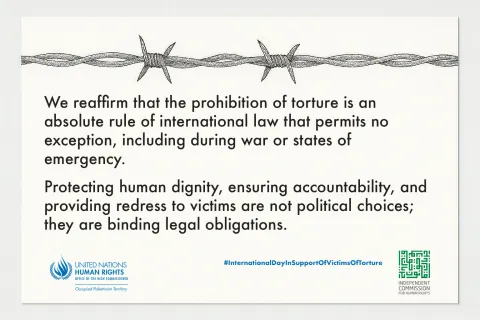
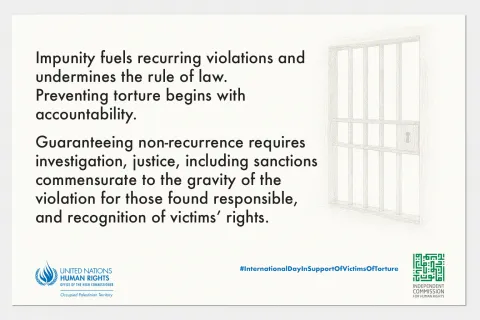
Human dignity is an inalienable right. The prohibition of torture is absolute regardless of the identity of the victim or the perpetrator. Justice for victims is a right, not a privilege.
Image
Social media card
Image
Social media card
5 February, 2026

Patterns of ill-treatment and coercion reported among Palestinians returning to Gaza

Patterns of ill-treatment and coercion reported among Palestinians returning to GazaFor the third consecutive day, Palestinians returning to Gaza through the newly reopened Rafah crossing have reporte...

Patterns of ill-treatment and coercion reported among Palestinians returning to Gaza

For the third consecutive day, Palestinians returning to Gaza through the newly reopened Rafah crossing have reported a consistent pattern of ill-treatment, abuse, and humiliation by Israeli military forces.

Palestinian returnees reported to the UN Human Rights Office in the Occupied Palestinian Territory being escorted after crossing by armed Palestinians allegedly backed by the Israeli military, to an Israeli military checkpoint. Consistent accounts indicate that some of these armed Palestinians handcuffed and blindfolded returnees, conducted searches, threatened and intimidated, and stole personal belongings and money.

Upon arrival at the Israeli checkpoint, returnees described a pattern of violence, degrading interrogations, and invasive body searches, in some cases while blindfolded and handcuffed. They also reported that soldiers denied them access to medical care when needed, and access to bathrooms, resulting in extreme humiliation, including being forced to urinate in public.

Several returnees said they were asked whether they would accept money to return to Egypt with their families and never return. Some said that they were offered money to become informants for the Israeli military.

Taken together, these accounts point to a pattern of conduct that violates Palestinians’ rights to personal security, dignity, and freedom from torture, ill-treatment, and other cruel, inhuman, or degrading treatment.

The reported pattern of conduct towards returnees raises serious concerns of coercion, discouraging Palestinians from exercising their right to return to areas they were forced to leave, further contributing to the ethnic cleansing of Gaza.

“The international community has a responsibility to ensure that all measures affecting Gaza strictly comply with international law and fully respect Palestinians’ human rights,” said Ajith Sunghay, head of the UN Human Rights Office in the OPT. “After two years of utter devastation, being able to return to their families and what remains of their homes in safety and dignity is the bare minimum.”

28 May, 2025

Unlawful killings in Gaza and the imperative for accountability

The apparent summary execution of an UNRWA staff member in Rafah on 23 March this year is truly shocking and must be promptly investigated, and those responsible brought to justice. It reflects a chil...

The apparent summary execution of an UNRWA staff member in Rafah on 23 March this year is truly shocking and must be promptly investigated, and those responsible brought to justice. It reflects a chilling pattern of violations of the basic principles of International Humanitarian Law. Related to the same incident, the Israeli military appears to have shot at clearly marked ambulances and rescue vehicles, killing eight Palestinian Red Crescent Society and seven Gaza Civil Defense staff. This appears to be an incident of deliberate targeting and killing of medical and humanitarian personnel in violation of international law. These killings reflect the Israeli military’s pattern of unlawful killings since the escalation of hostilities in Gaza began in October 2023.

UN Human Rights Office has documented numerous reports of possible extrajudicial executions and other unlawful killings, including the reported summary execution of members of the Anan family on 19 December 2023, the deliberate and systematic lethal targeting of members of the civilian police and the civil defence, the killing of journalists, and a pattern of attacks on fishers clearly neither participating in hostilities nor posing any threat to life or limb.

Palestinians have died in Israeli custody in situations that raise grave concerns that they were tortured and/or otherwise killed. In one example, the Israeli military arrested Dr. Adnan Ahmad Ateya Al Bursh, a senior orthopedic doctor on 17 December 2023 at Al Awda Hospital, North Gaza. He reportedly died on 19 April 2024 in Ofer Prison, an Israeli detention facility. According to witnesses he showed signs of torture and other ill-treatment, and his body is still being withheld by the Israeli authorities.

All of those reportedly killed are presumed to have been civilians and if they were targeted as such this would constitute a serious violation of IHL, as would the deliberate killing of any person within the power of a party. Under IHL, the parties to a conflict must at all times distinguish between civilians and combatants, and attacks may only be directed against combatants and other military objectives and never against civilians. Deliberately targeting or killing a civilian is a war crime.

Following the killings on 23 March, the Israeli Defense Forces dismissed the Deputy Commander of the Golani Battalion and issued a reprimand to the Commander of the 14th Brigade. Although the case was reportedly submitted to the Military Advocate General, no further accountability measures have been reported as of now. In addition, monitoring by the UN Human Rights Office confirms that such investigations in this context do not lead to effective accountability. UN Human Rights Office is gravely concerned that the prevalence of unlawful killings, including extrajudicial executions, and the repeated nature of these violations, as well as the apparent absence of effective steps from the Israeli military to repress and punish most of these cases, imply that these killings are not isolated events and indicate that they are condoned by the military and civilian hierarchy. In the absence of effective accountability within the Israeli military and judicial system, the international community must take steps to ensure effective investigations into all allegations of unlawful killings in the context of the escalation of hostilities in Gaza.